Currently Empty: $0.00
 Ifat Naseem
- April 20, 2026
- Comment 0

Artificial Intelligence (AI) is reshaping modern technology — but at its core lies mathematics. Every intelligent system, from chatbots and recommendation engines to self-driving cars, relies heavily on mathematical concepts to process data, learn patterns, and improve over time.
This beginner-friendly guide breaks down how mathematics powers AI in simple, practical terms. You’ll see how branches like algebra, calculus, and probability work together to make machine learning models smarter, more accurate, and more efficient — without needing an advanced math background to follow along.
What is Artificial Intelligence?
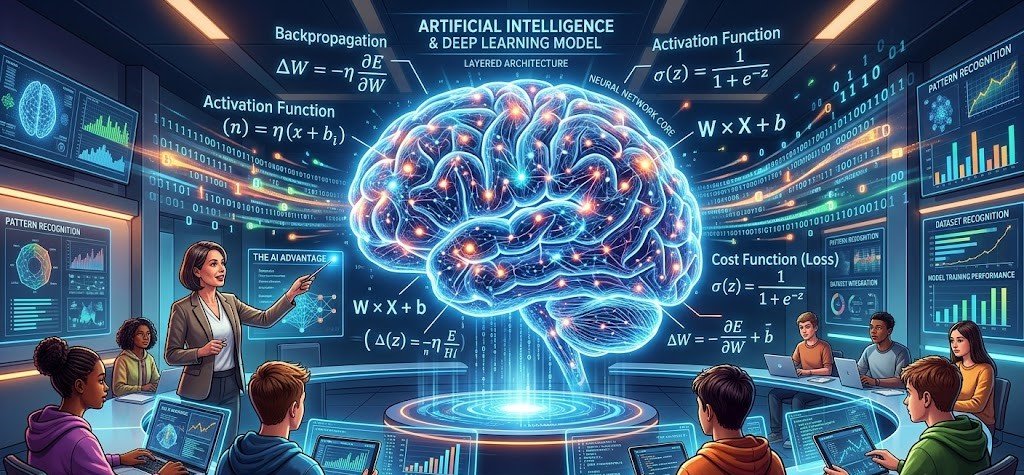
Artificial Intelligence (AI) is the ability of machines to analyze data, identify patterns, and make decisions in ways similar to human thinking. But this “intelligence” doesn’t come from nowhere — it’s built on mathematical models that process information behind the scenes.
Common examples include:
- Chatbots and virtual assistants (like Siri and Alexa)
- Netflix and YouTube recommendation systems
- Self-driving vehicles
- Spam filters and fraud detection
role—turningBehind every one of these systems, mathematics plays the key role — turning raw data into decisions.
Why Mathematics is Important in AI
Mathematics gives AI the structure it needs to think and act intelligently. It allows machine learning systems to:
- Make logical, data-driven decisions
- Identify hidden patterns in large datasets
- Continuously learn and improve performance over time
- Reduce errors and increase prediction accuracy
Without mathematics, AI systems would have no way to process information or improve — they’d simply be static programs with no ability to learn.
Main Branches of Mathematics Used in AI
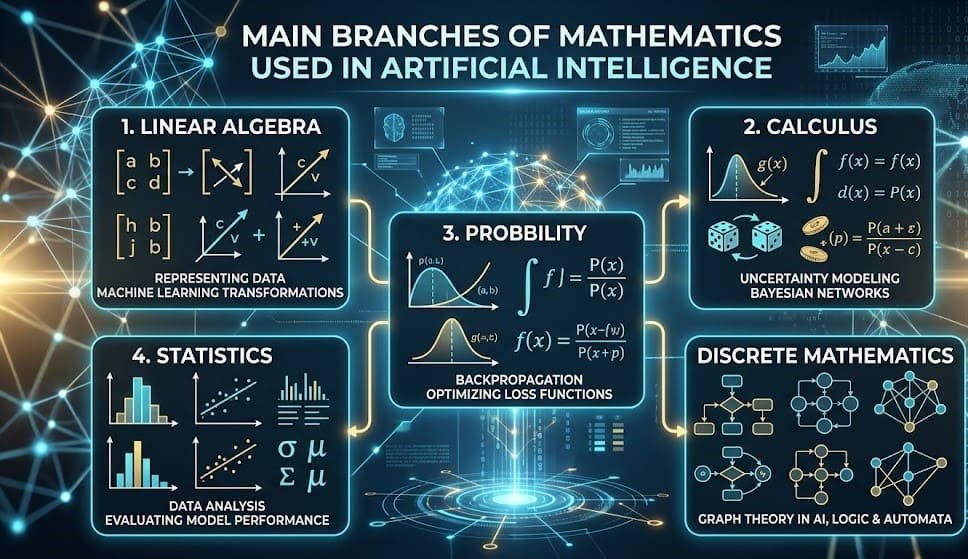
Let’s explore the core areas in a simplified way:
1. Linear Algebra — The Core Structure of AI
Linear algebra deals with vectors and matrices, which are essential for handling and organizing data in AI systems.
In AI, it helps with:
- Data representation
- Image and signal processing
- Neural network operations (weights, layers, transformations)
📌 Example: Images are converted into numerical matrices (grids of pixel values) so AI models can interpret and process them.
2. Calculus (Learning & Optimization)
Calculus enables AI systems to learn from their mistakes and continuously improve accuracy over time.
It is used for:
- Minimizing errors during training
- Optimizing machine learning models
- Adjusting weights in neural networks
📌 Example: AI uses optimization techniques like gradient descent to fine-tune predictions and reduce errors step by step.
3. Probability (Handling Uncertainty)
Probability allows AI to make informed predictions even when data is incomplete or uncertain.
It is used in:
- Prediction systems
- Risk evaluation
- Spam and fraud detection
- Recommendation algorithms
📌 Example: AI calculates the likelihood of an email being spam based on patterns in its content, sender, and past user behavior.
4. Statistics (Understanding Data)
Statistics helps AI analyze large datasets and discover meaningful patterns hidden within them.
It is used for:
- Data interpretation
- Model testing and validation
- Forecasting future trends
- Identifying correlations between variables
📌 Example: AI predicts future outcomes — like sales trends or weather patterns — based on historical data.
5. 🧮 Discrete Mathematics (Logic & Algorithms)
Discrete mathematics covers logic, graph theory, and set theory — the building blocks of computational thinking.
It is important for:
- Algorithm development
- Decision-making systems
- Data structures and search operations
📌 Example: Search engines like Google rely on graph theory to rank web pages based on how they link to one another.
🤖 Real-Life Applications of Math in AI
Mathematics powers many real-world AI systems that we use every day. Here’s how:
Recommendation Engines
Platforms like Netflix and YouTube use probability and statistics to analyze user behavior and suggest content you’re likely to enjoy.
Autonomous Vehicles
Self-driving cars use calculus and linear algebra to detect surroundings, calculate distances, and make split-second driving decisions.
Speech Recognition
Voice assistants convert spoken words into numerical data using mathematical models, allowing them to understand and respond to human speech.
Fraud Detection
Banks and payment platforms analyze transaction patterns using statistics and probability to identify suspicious or unusual activity in real time.
⚙️ Simple Example: AI Learning Process
Here’s a simple example of how AI combines different branches of math to solve a real problem — predicting house prices:
- Collect data — size, location, and price of existing houses
- Organize data — using linear algebra to structure it into a usable format
- Reduce errors — using calculus to fine-tune the prediction model
- Improve accuracy — using statistics to validate results against real patterns
Final result: An accurate, data-driven price estimation for new houses
🚀 Advantages of Mathematics in AI
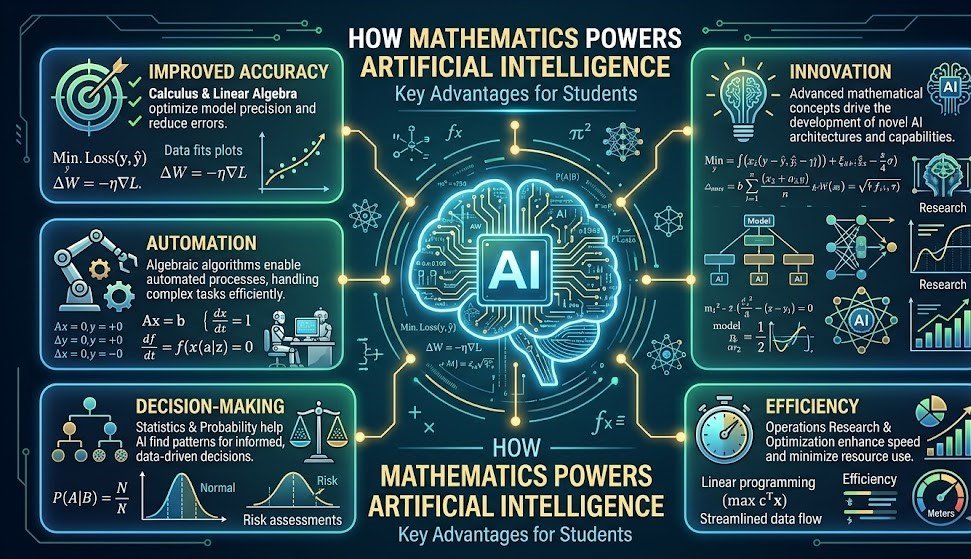
Mathematics gives AI systems a strong foundation, offering several key advantages:
Enables systems to learn and adapt over time
- Supports automation and reduces manual effort
- Improves decision-making accuracy
- Drives innovation in new technologies
- Enables systems to learn and adapt over time
Is Math Necessary for AI?
You don’t need to be an expert to start learning AI, but having basic math knowledge is very helpful for understanding how these systems actually work.
Start with:
- Algebra basics
- Basic probability
- Graph interpretation
Then gradually move on to more advanced concepts like calculus and linear algebra as you progress.
📚 Internal Resources for Better Understanding
To strengthen your knowledge of mathematics and its real-world applications, explore more articles on our website:
These topics will help you build a stronger foundation in mathematical thinking, which is essential for understanding artificial intelligence.
External Resources for Deep Learning
For further study and reliable knowledge about mathematics and AI, refer to these trusted sources:
- MIT OpenCourseWare – Machine Learning & Math
- Khan Academy – Linear Algebra
- Coursera – AI For Everyone
- Stanford Online – Artificial Intelligence Courses
These platforms provide high-quality educational material to help you understand how mathematics applies to artificial intelligence.
📚 How to Learn Math for AI
If you’re just getting started, here’s a simple approach to learning math for AI:
- Practice regularly, even 15-20 minutes a day
- Focus on understanding concepts, not just memorizing formulas
- Apply your knowledge to real-world problems and small projects
- Learn programming tools like Python once you’re comfortable with the basics
Understanding how mathematics drives artificial intelligence helps learners and developers build a strong foundation in AI and machine learning — highlighting how essential math is to creating truly intelligent systems.
Conclusion
This guide on how mathematics drives artificial intelligence shows that math is the true backbone of every intelligent system. From linear algebra and calculus to probability and statistics, these branches work together to help AI systems learn, adapt, and make accurate decisions.
Whether it’s a recommendation engine, a self-driving car, or a fraud detection system — every intelligent application relies on mathematical principles to function effectively and improve over time. Building even a basic understanding of these concepts will give you a strong foundation for exploring AI and machine learning further.
❓ FAQ Section (SEO Optimized)
Q1: Which math topics are important for AI?
Linear algebra, calculus, probability, and statistics are the most important branches, since they help AI systems process data, optimize models, and make accurate predictions.
Q2: Can I work in AI without math?
You can use pre-built AI tools without deep math knowledge, but understanding the underlying concepts is essential if you want to build, customize, or troubleshoot AI models yourself.
Q3: What is the role of calculus in AI?
Calculus is mainly used for optimization — it helps AI models minimize errors and improve accuracy through techniques like gradient descent during training.
Q4: Is AI only based on mathematics?
No. Math is the foundation, but AI also depends heavily on programming (like Python), large datasets, and computing power to function.
Q5: Do I need to be a math expert to start learning AI?
No — a basic understanding of algebra, probability, and statistics is enough to get started. You can build advanced math skills gradually as you progress.