
Currently Empty: $0.00

 Ifat Naseem
- April 26, 2026
- Comment 0

How Math Can Make You Successful in Trading (Beginner Guide)
Trading may look like a game of chance from the outside, but in reality, it is driven by logic, structure, and numbers. Those who consistently make money in trading are not relying on luck — they are following a system built on mathematical thinking.
Understanding how math can make you successful in trading starts with one simple shift: thinking like a strategist instead of a gambler. Every decision should be backed by numbers, not emotions.
Professional traders rely on calculations such as risk management, probability, and position sizing — not because it sounds impressive, but because it works. You don’t need advanced formulas to get started — just a clear understanding of a few core principles.
Many experts agree that trading success depends more on discipline and mathematical thinking than on predicting market movements. When you consistently apply these principles, results follow. It all comes down to consistency, planning, and smart decision-making.
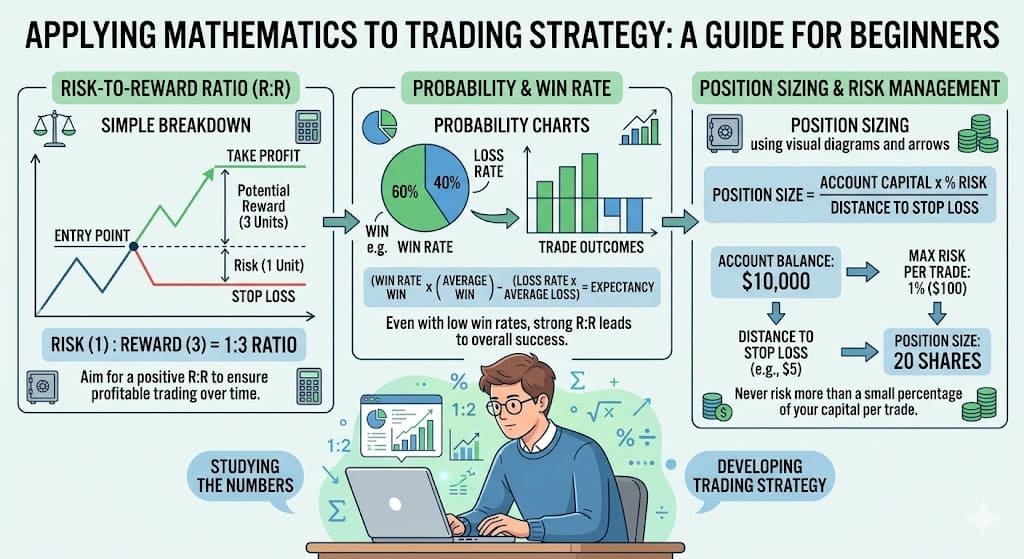
The Importance of Math in Trading
Many beginners struggle because they rely on emotions instead of logic. Fear leads to early exits, and greed leads to risky decisions. Math helps eliminate this problem by giving you a clear, rule-based framework to follow.
Using math in trading allows you to:
- Measure potential gains and losses
- Control how much you risk on each trade
- Evaluate trading opportunities objectively
- Build a consistent and repeatable system
Without a structured approach, trading becomes unpredictable and emotionally draining. With math, it becomes manageable — and far more profitable over time.
Key Mathematical Concepts for Traders
You only need a few essential concepts to start trading effectively:
Risk and Reward Balance
Before entering any trade, you should always know two things: how much you are willing to lose, and how much you expect to gain. This is called the risk-to-reward ratio, and it is one of the most important concepts in trading.
The idea is simple — if your potential profit is higher than your potential loss, the trade is worth considering.
Example:
| Amount | |
|---|---|
| Possible Loss | $10 |
| Possible Profit | $30 |
| Risk-to-Reward Ratio | 1:3 |
In this setup, you are risking $10 to potentially earn $30. This means even if you lose 2 out of 3 trades, you can still break even — and with a better win rate, you stay consistently profitable.
Understanding Probability
In trading, no outcome is guaranteed. What truly matters is not whether you win or lose a single trade — it is how your results perform consistently over multiple trades.
Even skilled and experienced traders face losses regularly. What keeps them profitable is a well-designed system that works in their favor over the long run. This is where probability thinking becomes essential.
Consider this simple example:
| Scenario | Trades Lost | Trades Won | Result |
|---|---|---|---|
| Small losses, bigger wins | 6 | 4 | Still Profitable |
If your winning trades earn more than your losing trades cost you, you can lose more often than you win — and still grow your account. Several small losses can easily be recovered by fewer but larger gains.
This is exactly why focusing on long-term results is far more important than reacting to individual trades. One bad trade means nothing — your overall system does.
Managing Trade Size (Position Sizing)
Another important concept in trading is deciding how much money to allocate to each trade. This is commonly known as position sizing, and it directly affects how long you can survive in the market.
A widely followed rule among professional traders is the 1% Rule — never risk more than 1% to 2% of your total account balance on a single trade.
Example:
| Account Balance | Max Risk Per Trade (1%) | Max Risk Per Trade (2%) |
|---|---|---|
| $500 | $5 | $10 |
| $1,000 | $10 | $20 |
| $5,000 | $50 | $100 |
This simple rule does two things — it protects your account from big losses, and it allows you to keep trading even after a losing streak. Without proper position sizing, even a few bad trades can wipe out your entire balance.
Building a Simple Trading Approach Using Math
You can create a basic yet effective trading system by following these four steps. The goal is not to predict the market perfectly — it is to make decisions that are logical, consistent, and backed by numbers.
Step 1: Decide Your Risk Level
Before placing any trade, choose a fixed amount or percentage you are comfortable losing. Stick to this number no matter what.
Step 2: Plan Your Profit Target
Set a profit target that is at least 2x to 3x your risk. This ensures that even with a lower win rate, your account grows over time.
Step 3: Adjust Your Position Size
Based on your risk amount, calculate how many units or lots to trade. Never increase your size out of emotion or overconfidence.
Step 4: Stay Consistent
Common Mistakes Beginners Make in Trading
Even with the right knowledge, many beginners fall into the same traps. Here are the most common mistakes — and how to avoid them:
❌ Mistake 1: No Clear Plan
Entering trades randomly, based on gut feeling or tips, almost always leads to losses. Before placing any trade, define your entry point, stop loss, and profit target.
❌ Mistake 2: Trading Too Frequently
More trades do not mean more profits. Overtrading leads to higher fees, emotional fatigue, and poor decision-making. Focus on high-quality setups only.
❌ Mistake 3: Ignoring Risk Control
Risking too much on a single trade can damage your account beyond recovery. Always keep your risk small and controlled — follow the 1% rule discussed earlier.
Example: Growing a Small Account With Math
Imagine starting with just $100. By applying the principles covered in this guide — risking a small fixed percentage per trade, aiming for a reward at least 2x your risk, and staying consistent — your account can grow steadily over time.
| Month | Starting Balance | Trades Won | Estimated Growth |
|---|---|---|---|
| Month 1 | $100 | 6/10 | $115 |
| Month 2 | $115 | 6/10 | $132 |
| Month 3 | $132 | 6/10 | $152 |
The key factor is consistency, not speed. Small, steady gains compound into significant results over time.
Advanced Concepts to Explore Later
Once you are comfortable with the basics, you can gradually expand your knowledge into these areas:
- Trend Analysis — identifying market direction using moving averages and chart patterns
- Support and Resistance Levels — finding key price zones where markets tend to react
- Data-Based Decision Making — using backtesting and trading journals to refine your strategy
Discipline + Math = Trading Success
Math provides the strategy, but your mindset determines whether you actually follow it. Even the most well-designed trading system will fail if you abandon it the moment emotions take over. This is why discipline is just as important as any formula or calculation.
To consistently improve your trading results, keep these principles in mind:
- Stick to your plan — Define your rules before the market opens, and follow them without exception
- Avoid emotional decisions — Never enter or exit a trade based on fear, excitement, or frustration
- Trust your system — A single losing trade does not mean your strategy is broken. Stay the course and let the math work over time
To build your understanding, you can explore platforms like:
Investopedia
TradingView
BabyPips
Conclusion
Math is not a shortcut to instant wealth, but it is one of the most powerful tools you can use to build consistent success in trading. When applied correctly, it removes guesswork and replaces it with a clear, logical system.
It helps you:
- Make informed decisions — based on numbers, not emotions
- Control your risks — so one bad trade never destroys your account
- Build long-term growth — through consistency and discipline, not luck
In the end, trading success comes from patience, discipline, and the smart use of mathematics. The traders who win consistently are not the ones who predict the market perfectly — they are the ones who manage their risk perfectly.
Start small, stay focused, and let your strategy work over time.
Also Read:
Top 10 Math Formulas for Trading Beginners (Complete Guide)
How Mathematics Drives Artificial Intelligence (Simple Guide)
Frequently Asked Questions (FAQs)
Q1: Is advanced math required for trading?
No, advanced math is not required. Basic concepts like percentages, ratios, and simple probability are more than enough for beginners to build a profitable trading system.
Q2: What is the most important factor in trading success?
Proper risk management is the single most important factor. Even the best trading strategy will fail without consistent risk control. Keeping your losses small and manageable is what allows you to stay in the game long enough to profit.
Q3: Can beginners grow their accounts using math?
Absolutely. With consistent application of position sizing, risk-to-reward ratios, and probability thinking, even a small account of $100 can grow steadily over time. The key is discipline and patience — not the size of your starting balance.