
Currently Empty: $0.00

 Ifat Naseem
- April 8, 2026
- Comment 0

Introduction
Trading is not just about luck — it’s about numbers, logic, and smart calculations. If you want to succeed in the stock or crypto market, understanding basic math formulas is essential.
In this guide, you’ll learn the top 10 math formulas for trading beginners that will help you:
- Manage risk effectively
- Calculate profits and losses accurately
- Make data-driven trading decisions
Even if you’re not a math expert, don’t worry — these formulas are simple, practical, and beginner-friendly.
Disclaimer: This guide is for educational purposes only and is not financial advice. Trading involves risk, and you should do your own research or consult a financial advisor before making investment decisions.
Why Math Formulas for Trading Beginners Are Essential
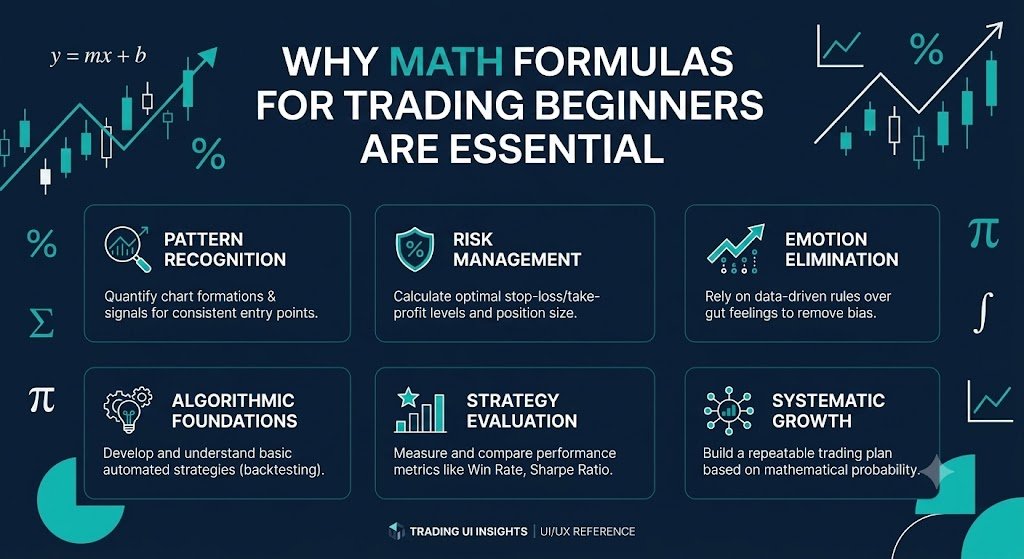
Understanding basic math formulas is the foundation of becoming a successful trader. Without proper calculations, trading becomes more like gambling than a strategic activity. These formulas help beginners analyze price movements, calculate risk, and estimate potential profit before entering any trade.
For example, applying the right formulas lets you quickly judge whether a trade is worth taking. Instead of relying on emotions, you make decisions based on numbers and logic — an approach that reduces losses and improves consistency over time.
Learning these formulas also builds confidence. As a new trader, charts and market trends can feel overwhelming, but the right calculations make everything clearer and more structured. In simple words, these formulas act as your roadmap in the trading journey.
Percentage Change Formula
Formula:
Percentage Change=OldPrice(NewPrice−OldPrice)×100
Example:
If a stock price goes from $100 to $120:100(120−100)×100=20%
Why It Matters:
Knowing the percentage change helps you quickly gauge how much a stock or asset has moved, making it easier to spot trends, compare performance across different stocks, and decide whether a trade is worth taking
Profit and Loss Formula
Formula:
Profit/Loss=SellingPrice−BuyingPrice
Example:
Buy at $50, sell at $70 → Profit = $20
Why It Matters:
This is the foundation of trading — knowing whether you’re making or losing money on every position and by how much, is essential before you can manage risk or plan your next move.
Risk to Reward Ratio
Formula:
Risk/Reward = Potential Profit/Potential Loss
Example:
Risk = $10, Reward = $30 → Ratio = 1:3
Why It Matters:
Professional traders always aim for a higher potential reward than the risk they’re taking. A risk-to-reward ratio of 1:2 or 1:3 is generally considered ideal — meaning for every $1 risked, you aim to make $2 or $3 in return.
4. Stop Loss Calculation
Formula:
Stop Loss=EntryPrice−RiskAmount
Example:
Entry = $100, Risk = $5 → Stop Loss = $95
Why It Matters:
A stop loss protects your capital by automatically closing a trade before losses grow too large — helping you stay in the game even after a bad trade.
5. Position Size Formula
Formula:
Position Size = Trade Risk / Account Risk
Example:
Account Risk = $100, Trade Risk = $5 → Position Size = 20 shares
Why It Matters:
Helps you decide exactly how much to invest per trade — keeping your risk consistent and under control across every position, no matter the stock’s price.
6. Moving Average (Simple Moving Average – SMA)
Formula:
SMA=Number of PeriodsSum of Prices
Example:
Prices: 10, 20, 30 → SMA = 20
Why It Matters:
Used to identify market trends and smooth out short-term price fluctuations, making it easier to see the bigger picture in noisy price data.
7. Exponential Moving Average (EMA)
Formula:
EMA=(Price×Multiplier)+(PreviousEMA×(1−Multiplier))
Why It Matters:
EMA (Exponential Moving Average) reacts faster to recent price changes than SMA (Simple Moving Average), helping traders catch quick market movements and react sooner to trend reversals.
8. Return on Investment (ROI)
Formula:
ROI=InvestmentNetProfit×100
Example:
Profit = $200, Investment = $1000 → ROI = 20%
Why It Matters:
Measures how profitable your trading strategy is overall, helping you see whether your winning trades are actually outweighing your losing ones over time.
9. Break-Even Point
Formula:
Break-even=BuyingPrice+Costs
Example:
Buy at $100, fees = $5 → Break-even = $105
Why It Matters:
Tells you the exact price at which a trade neither makes a profit nor a loss — this is your breakeven point, and any move beyond it puts you in profit or loss.
10. Compound Interest Formula (Trading Growth)
Formula:
A=P(1+r)n
Where:
- P = Initial investment
- r = interest rate
- n = time
Example:
$1000 at 10% for 2 years:1000(1.1)2=1210
Why It Matters:
Shows how your trading capital can grow over time when profits are reinvested consistently — highlighting the power of compounding in long-term trading.
Pro Tips for Beginners
- Always apply risk management formulas before entering a trade
- Never risk more than 1–2% of your capital per trade
- Combine math-based analysis with technical analysis (charts, patterns)
- Practice on demo accounts before trading with real money
Internal Linking Suggestion
You can also learn:
External Resource
For deeper understanding, explore trusted financial education platforms like Investopedia, which offers real-world examples and beginner trading strategies.
Conclusion
Mastering these top 10 math formulas for trading beginners can completely change your trading journey. Instead of guessing, you’ll start making calculated, strategic decisions backed by real numbers.
Remember: Trading success = Math + Discipline + Strategy.
Start practicing these formulas daily, and you’ll quickly build the confidence needed to navigate the market with clarity.
FAQ Section
Q1: Do I need to be good at math to start trading?
No — you don’t need advanced math skills. Basic arithmetic and a few key formulas like percentage change, risk-to-reward ratio, and position sizing are enough to get started.
Q2: Which math formula is most important for beginner traders?
The risk-to-reward ratio and position sizing formula are considered the most important, since they directly control how much capital you risk on each trade.
Q3: Can these formulas guarantee profit in trading?
No formula can guarantee profit. These formulas help you manage risk and make more informed, calculated decisions, but trading always involves market uncertainty and potential losses.
Q4: What is the difference between SMA and EMA?
SMA (Simple Moving Average) gives equal weight to all prices in a period, while EMA (Exponential Moving Average) reacts faster to recent price changes, making it more useful for spotting quick trend shifts.
Q5: How much should I risk per trade as a beginner?
Most experienced traders recommend risking no more than 1–2% of your total capital on a single trade to protect your account from large losses.