
Currently Empty: $0.00
 Ifat Naseem
- May 10, 2026
- Comment 0

In this article, we uncover The Hidden Mathematics ofSocial Media Algorithms and explain how digital platforms.predict what users want to see next. Understanding.The Hidden Mathematics of Social Media Algorithms is essential for anyone who wants to know how TikTok,Instagram and YouTube really work.
Have you ever wondered why TikTok, Instagram, and YouTube always show exactly what you want to see? Whether you are watching short videos, browsing photos, or streaming content, the experience feels perfectly matched to your interests.
But this personalization is not accidental.
Behind every recommendation lies a powerful world of mathematics, artificial intelligence, and behavioral analysis. Every click, like, comment, and second you spend watching content helps platforms understand your preferences more accurately.
In this article, we uncover the hidden mathematics of social media algorithms and explain how digital platforms predict what users want to see next.
What Is a Social Media Algorithm?
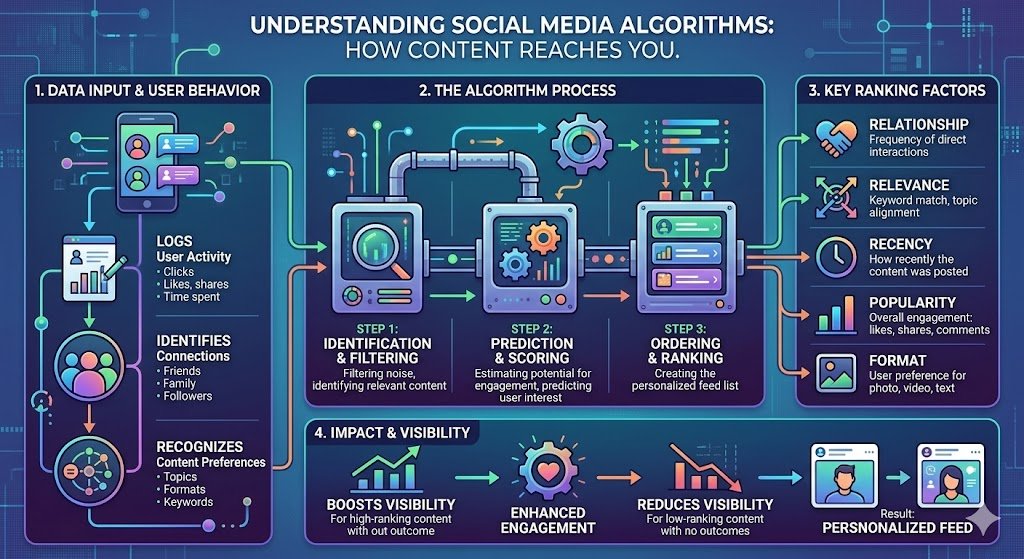
A social media algorithm is a smart computational system designed to organize and rank content for users. Instead of displaying posts randomly, these systems prioritize content based on user behavior and engagement patterns.
Algorithms examine signals such as:
- Viewing history
- Content interactions
- Watch time
- Comments and shares
- Search activity
- User interests
- Following behavior
The main purpose is to maximize engagement by keeping users active on the platform for longer periods. The longer users stay engaged, the more opportunities platforms have to display advertisements and increase revenue.
Why Understanding the Hidden Mathematics of Social Media Algorithms Matters
The hidden mathematics of social media algorithms is not just a technical concept reserved for engineers and data scientists — it is the invisible force that shapes what millions of people see, share, and believe every single day. When you scroll through your feed, the hidden mathematics of social media algorithms is silently calculating engagement probabilities, predicting your next click, and deciding which content deserves your attention. Brands that master the hidden mathematics of social media algorithms consistently outperform competitors who rely on guesswork alone. Whether you are a content creator, marketer, or casual user, understanding the hidden mathematics of social media algorithms gives you a strategic advantage in an increasingly crowded digital landscape. From weighted scoring systems to matrix factorization, these mathematical models are constantly evolving—and staying ahead requires knowing how the hidden mathematics of social media algorithms works beneath the surface.
1. How Probability Shapes Content Recommendations
Probability is one of the core mathematical concepts used in The Hidden Mathematics of Social Media
Algorithms to power recommendation systems.
Algorithms calculate the likelihood that a user will enjoy specific content based on previous interactions. For example, if someone regularly watches educational videos and follows science creators, the system predicts a strong probability that similar content will also attract their attention.
A simplified formula looks like this:
P(Interest | Previous Behavior)
This represents the probability of user interest based on past activity. As users continue interacting with content, these probability estimates constantly evolve and become more accurate.
2. Machine Learning and User Behavior Analysis
Machine learning allows algorithms to improve automatically over time.Machine learning is a key part of The Hidden Mathematics of Social Media Algorithms that allows platforms to
improve recommendations automatically over time.
Social media platforms process massive amounts of user data to identify patterns in behavior. They compare similarities between users and analyze engagement trends to make better recommendations.
For example, if people who enjoy productivity videos also frequently engage with business content, the algorithm learns this relationship and starts recommending business videos to similar audiences.
This ability to recognize patterns is what makes recommendation systems increasingly accurate over time.
3. The Importance of Linear Algebra in Algorithms
Linear algebra plays a major role in modern recommendation systems.
Platforms convert users, videos, and interests into mathematical vectors and matrices. These numerical representations help algorithms measure similarities between different types of content and user preferences.
One commonly used technique is cosine similarity.
Cosine Similarity Formula
Similarity = A·B / (||A|| × ||B||)
This mathematical calculation helps platforms:
- Recommend related content
- Detect similar users
- Personalize feeds
- Improve recommendation accuracy
Without linear algebra, social media algorithms would struggle to deliver personalized experiences efficiently.
4. Why TikTok’s Recommendation System Is So Powerful
TikTok is widely recognized for its advanced content recommendation engine.
Its algorithm carefully studies:
- Video watch duration
- Replay frequency
- Swipe behavior
- User engagement
- Interaction consistency
When users watch videos completely or replay them multiple times, the algorithm interprets this as strong interest. The platform then promotes that content to users with similar viewing habits.
This system relies heavily on predictive analytics, statistical modeling, and artificial intelligence. That is one reason why videos can become viral so quickly on TikTok compared to other platforms.
TikTok’s success is a perfect real-world example of how The Hidden Mathematics of Social Media Algorithms
works in practice.
5. The Mathematics Behind Engagement Scores
Engagement scoring systems help algorithms determine which content deserves greater visibility.
Different user actions carry different values. Shares and saves are considered more important than simple likes because they indicate stronger interest.
A simplified engagement equation looks like this:
Engagement Score = Likes + (Comments × 3) + (Shares × 5)
Although actual algorithms are much more complex, this example demonstrates how platforms mathematically rank content performance. Higher engagement usually increases the chances of content appearing on more users’ feeds.
6. Data Science and Personalized Experiences
Social media companies gather huge amounts of behavioral data daily.
Algorithms monitor:
- Active browsing times
- Content preferences
- Scroll pauses
- Ignored posts
- Clicking patterns
Using data science and predictive analysis, platforms create highly detailed digital profiles for every user. This helps companies personalize feeds, deliver targeted advertisements, recommend new creators, and predict future interests.
The result is a highly customized online experience that feels unique to every individual user.
7. Artificial Intelligence and Neural Networks
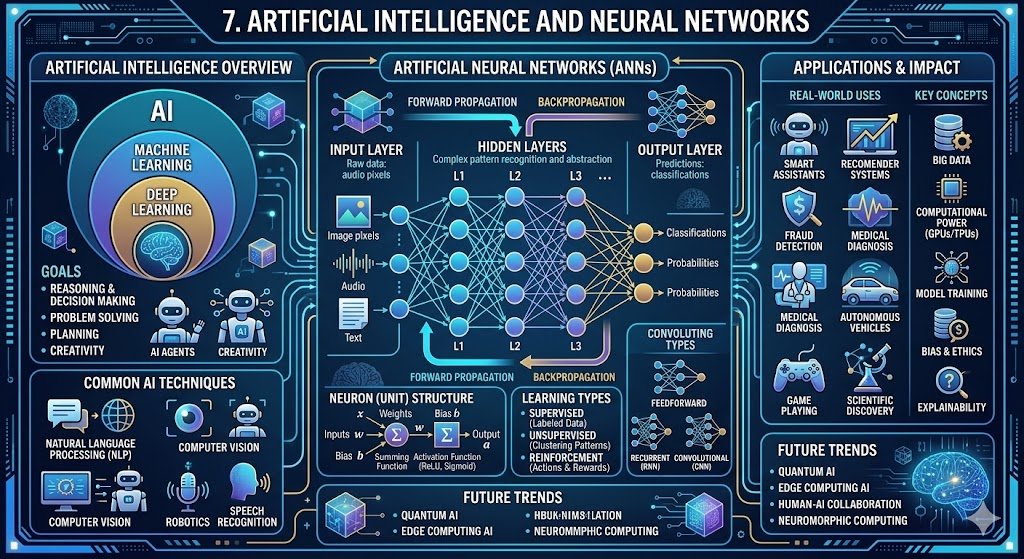
Modern recommendation systems are strongly powered by artificial intelligence.
Many platforms use neural networks — AI systems designed to mimic human learning processes. These systems continuously analyze user interactions and improve recommendation accuracy over time.
As more data becomes available, AI systems become smarter and more efficient at predicting user preferences. This explains why recommendations often feel surprisingly precise after just a few minutes of use.
How Algorithms Influence Online Behavior
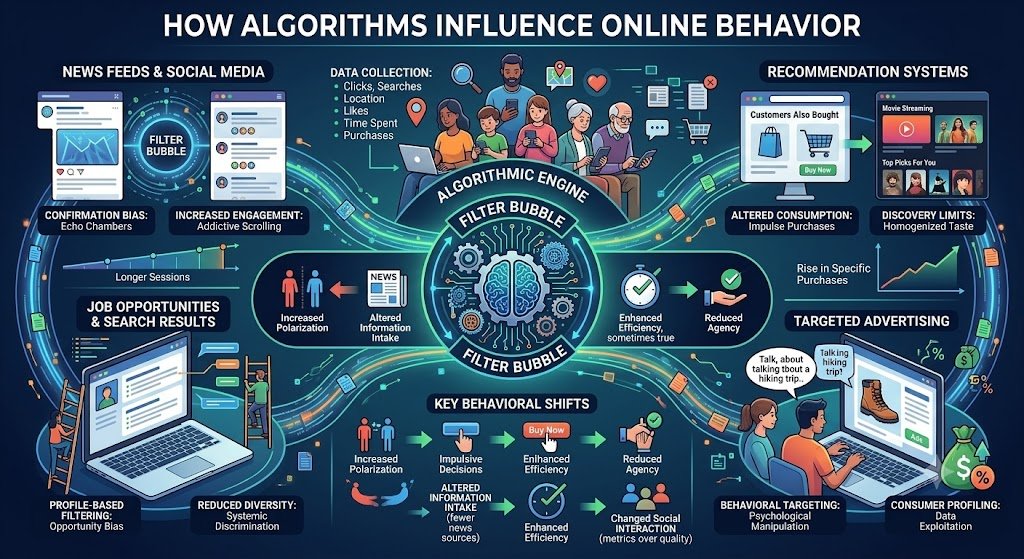
Social media algorithms do not only predict interests — they can also shape them.
Repeated exposure to certain topics may influence personal opinions, viewing habits, consumer behavior, and online interests. Over time, this can create “filter bubbles” where users mainly encounter content aligned with their existing preferences.
Understanding how these systems work helps users become more aware of the digital environments they interact with daily.
The Future of Social Media Algorithms
As artificial intelligence continues advancing, social media algorithms are expected to become even more intelligent.
Future developments may include:
- Real-time personalization
- Emotion-based recommendations
- Advanced deep learning systems
- Predictive user behavior models
- AI-generated content suggestions
Mathematics will remain the foundation of these evolving technologies for years to come.
Conclusion
Social media platforms rely on mathematics, artificialintelligence, and data science to understand user behavior and deliver personalized content recommendations. Concepts such as probability, machine learning, statistics, and linear algebra help algorithms decide what users see everyday. By understanding The Hidden Mathematics of Social Media Algorithms, we gain valuable insight into how digital platforms influence our online experiences and shape modern internet culture.
Internal Links
External Resources
FAQs
How do social media algorithms recommend content?
They analyze user behavior, engagement, and viewing patterns using mathematical and AI-based systems.
Which mathematical concepts are used in recommendation systems?
Probability, statistics, linear algebra, machine learning, and predictive analytics are commonly used.
Why is TikTok’s algorithm considered highly effective?
Because it continuously studies user interactions and quickly adapts recommendations using AI models.
Can algorithms influence user interests?
Yes. Repeated exposure to certain content can shape preferences and online behavior over time.
Are social media algorithms powered by artificial intelligence?
Most modern platforms use AI and neural networks to improve recommendation accuracy and personalization.