
Currently Empty: $0.00
 Ifat Naseem
- October 25, 2025
- Comment 0

Embracing Digital Transformation in Math Learning
The way students learn mathematics has changed dramatically over the last decade. Mathematics education in the digital age has revolutionized how teachers instruct and how students understand complex concepts — making math more accessible, engaging, and effective than ever before.
The traditional classroom model of textbooks and blackboards is rapidly evolving into a dynamic, technology-enhanced learning environment where students can visualize problems, get instant feedback, and learn at their own pace.
Why Mathematics Education in the Digital Age Matters More Than Ever
The importance of mathematics education in the digital age cannot be overstated. In a world where technology drives every industry — from healthcare to finance, from engineering to artificial intelligence — strong mathematical foundations are no longer optional. Mathematics education in the digital age equips students with the critical thinking, problem-solving, and analytical skills they need to thrive in tomorrow’s job market. Schools and educators who invest in modernizing their math teaching today are directly preparing their students for a future that will demand these skills more than ever before.
The Growing Importance of Mathematics Education in the Digital Age
Across the globe, governments, schools, and parents are beginning to recognize that mathematics education in the digital age is not just a trend — it is a necessity. Research consistently shows that students who engage with mathematics education in the digital age through interactive and technology-driven methods perform significantly better in standardized tests, develop stronger problem-solving abilities, and show greater confidence in applying math to real-life situations.
How Mathematics Education in the Digital Age Benefits Every Student
Whether you are a teacher, a parent, or a student, understanding how mathematics education in the digital age impacts learning outcomes is essential. Studies from leading educational institutions worldwide confirm that mathematics education in the digital age leads to better student results, higher engagement rates, and more inclusive classrooms where every learner — regardless of ability or background — gets the support they need to succeed.
Real Impact of Mathematics Education in the Digital Age on Student Performance
Educators around the world agree that mathematics education in the digital age has created a measurable and positive impact on student performance. From primary school classrooms to university lecture halls, mathematics education in the digital age is helping students build stronger foundations, close learning gaps faster, and develop a genuine love for mathematics that traditional methods alone could never achieve.
The Evolution of Math Teaching Methods
From Traditional to Technological Approaches

For decades, math was taught the same way — a teacher at a blackboard, students copying notes, and textbooks as the only resource. While this method worked for many, it left behind students who needed a different approach to truly understand mathematical concepts.
Today, the shift from conventional teaching to digital platforms has completely changed this picture. Students now have access to interactive tools, simulation software, and AI-powered apps that bring abstract concepts to life in ways a textbook never could.
This transition is not just about using technology — it is about making math more understandable, more visual, and more relevant to real life.
Key Technologies Reshaping Math Education
Interactive Learning Platforms
Modern math classrooms are no longer limited to physical tools. Today, platforms like Khan Academy and GeoGebra are leading the way in making mathematics more visual, interactive, and student-friendly.
These platforms give students and teachers powerful tools including:
- Visual representation of complex concepts — turning difficult formulas into easy-to-understand graphics
- Step-by-step problem solving — guiding students through each stage of a math problem
- Instant feedback mechanisms — letting students know immediately where they went wrong
- Personalized learning paths — adjusting difficulty based on each student’s progress
💡 Want to learn more? Read our detailed guide on How Technology is Reshaping Mathematics Education
Artificial Intelligence in Math Learning
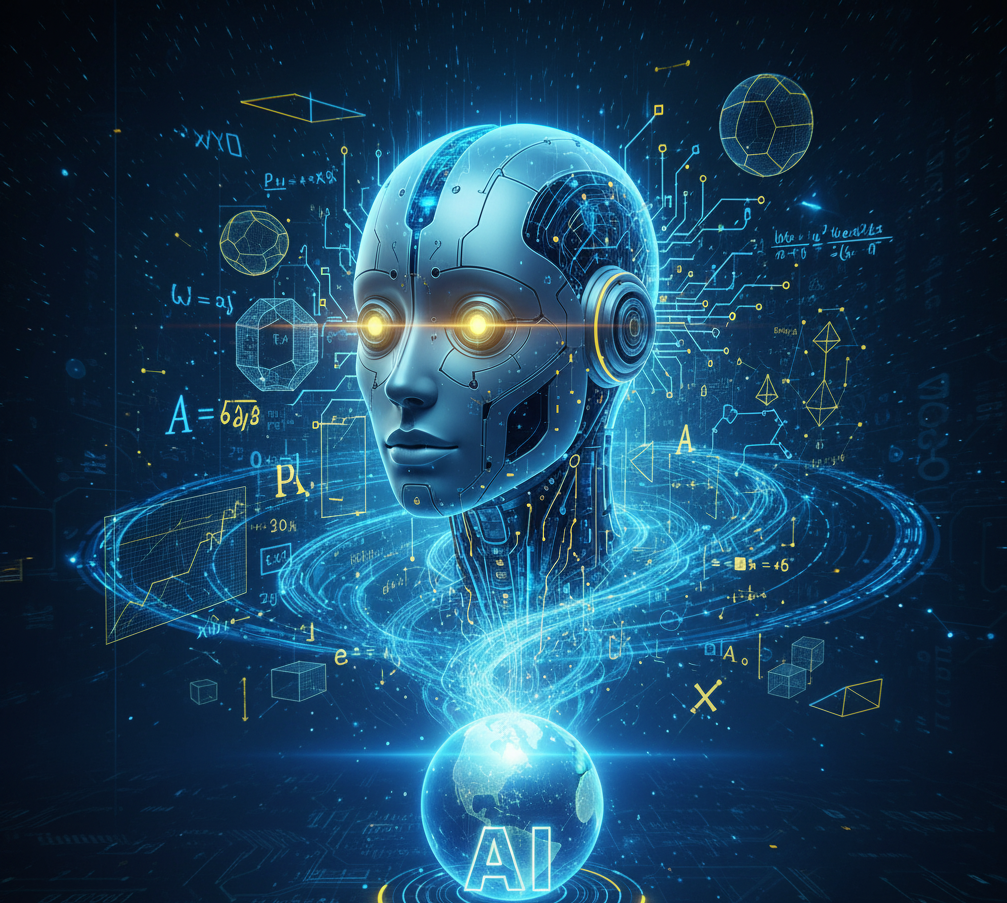
Artificial Intelligence is one of the most exciting developments in modern math education. Unlike traditional teaching tools, AI actively responds to each student’s performance and adjusts the learning experience in real time.
Here is how AI is transforming the way students learn mathematics:
- Adaptive learning algorithms — AI analyzes a student’s strengths and weaknesses and automatically adjusts the difficulty of problems accordingly
- Personalized difficulty levels — every student gets a unique learning experience tailored to their own pace and skill level
- Intelligent tutoring systems — AI-powered tutors guide students through problems step by step, just like a real teacher would
- Automated assessment tools — teachers save hours of marking time as AI instantly evaluates student work and generates detailed performance reports
💡 The biggest advantage of AI in math education is that no two students have to follow the exact same path — everyone learns in the way that works best for them.
Gamification Strategies in Math Learning
One of the most effective ways to keep students engaged in mathematics is through gamification — turning learning into a fun, rewarding experience. When students enjoy what they are doing, they naturally learn faster and retain more.
Game-based learning has brought exciting new elements into math classrooms, including:
- Reward systems and achievements — students earn points, badges, and rewards as they complete math challenges, keeping them motivated to continue
- Progress tracking features — students can visually see how far they have come, which builds confidence and encourages them to keep going
- Competitive learning environments — friendly leaderboards and math challenges between classmates make learning feel like a game rather than a chore
- Engaging story-based challenges — math problems are presented inside interesting stories and adventures, making abstract concepts feel relevant and exciting
💡 Research shows that students who learn through gamified platforms spend significantly more time practicing math compared to traditional methods — simply because it feels fun!
Benefits of Digital Math Education
Enhanced Student Engagement
One of the most visible benefits of digital math education is the dramatic increase in student participation and interest. When math moves beyond textbooks and into interactive screens, videos, and games — students naturally pay more attention.
Digital tools boost engagement in several important ways:
- Interactive content keeps students actively involved instead of passively listening to a lecture
- Immediate feedback systems tell students right away whether their answer is correct, removing the frustration of waiting days for a graded paper
- Visual and animated explanations make even the most difficult math concepts easier to understand and remember
- Self-paced learning allows students to revisit concepts as many times as they need without feeling embarrassed in front of classmates
💡 Studies consistently show that students who learn through digital platforms are more likely to complete their practice work — simply because the experience feels more engaging and less stressful than a traditional classroom.
Personalized Learning Experiences
Every student learns differently — some grasp concepts quickly while others need more time and repetition. This is where digital math tools have a clear advantage over traditional classroom teaching.
The digital approach to modern math education makes personalization possible in ways that were never achievable before:
- Customized learning pace — students are never rushed or held back; they move forward only when they are truly ready
- Targeted skill development — the system identifies exactly which topics a student is struggling with and focuses practice on those specific areas
- Individual progress monitoring — both students and teachers can track performance in real time through detailed dashboards and reports
- Adaptive challenge levels — as a student improves, the difficulty automatically increases to keep them challenged and growing
💡 Personalized learning means that a student who struggles with fractions gets more fraction practice, while a student who excels moves ahead to advanced topics — all within the same classroom and at the same time.
Improved Conceptual Understanding
One of the biggest challenges in traditional math teaching has always been helping students truly understand a concept — not just memorize a formula. Digital learning tools have made this significantly easier.
Through interactive and visual technology, students in modern math classrooms can now:
- Visualize abstract concepts — instead of imagining what a graph or geometric shape looks like, students can see it move and change on screen in real time
- Explore mathematical relationships — digital tools allow students to experiment with numbers and equations, discovering patterns on their own rather than just being told the answer
- Connect theory with practical applications — students can see exactly how a math concept applies to real life, making it far more meaningful and memorable
- Develop deeper comprehension — by interacting with content rather than passively reading it, students build a stronger and longer-lasting understanding of mathematical ideas
💡 When a student can see why a formula works instead of just memorizing it, they are far less likely to forget it — and far more likely to apply it correctly in an exam.
Challenges in Implementing Digital Math Education
Accessibility and Equity Issues
While digital tools have brought incredible improvements to modern math learning, it is important to acknowledge that not every student has equal access to these benefits. Accessibility and equity remain some of the most pressing challenges facing educators and policymakers today.
Here are the key barriers that still need to be addressed:
- Digital divide among students — many students in rural or low-income areas simply do not have access to smartphones, tablets, or computers needed for digital learning
- Unequal access to technology — even within the same school, some students have the latest devices at home while others share a single device with an entire family
- Infrastructure limitations — reliable internet connectivity is still not available in many parts of the world, making online math platforms completely inaccessible
- Socioeconomic barriers — premium digital learning tools and apps often come with subscription costs that low-income families simply cannot afford
💡 True progress in digital math education can only happen when every student — regardless of their background or location — has equal access to the same quality of learning tools and resources.
Teacher Training Requirements
Even the best digital tools are only as effective as the teachers who use them. One of the most overlooked challenges in mathematics education in the digital age is ensuring that educators are fully prepared to integrate technology into their classrooms confidently and effectively.
Successful implementation of digital math teaching requires:
- Comprehensive teacher development — teachers need structured training programs that go beyond basic tool usage and focus on how to actually improve student outcomes through technology
- Technical support systems — schools must provide reliable IT support so that teachers are never left struggling with technical issues during a lesson
- Curriculum adaptation strategies — existing math curriculums need to be thoughtfully redesigned to incorporate digital tools in a way that enhances rather than disrupts the learning flow
- Ongoing professional training — technology evolves rapidly, so teacher training cannot be a one-time event — it must be a continuous process that keeps educators up to date with the latest tools and methods
💡 Investing in teacher training is just as important as investing in the technology itself. A well-trained teacher with basic tools will always outperform an untrained teacher with the most advanced software.
Effective Digital Teaching Strategies
Blended Learning Models
The most successful schools today are not going fully digital overnight — instead, they are combining the best of both worlds. Blended learning models bring together traditional teaching methods and modern digital tools to create a balanced and highly effective approach to mathematics education in the digital age.
Here are the key blended learning strategies making a real difference in math classrooms:
- Flipped classroom approaches — students watch video lessons at home and use classroom time for hands-on problem solving and discussion with their teacher
- Hybrid assessment techniques — teachers combine traditional written tests with digital quizzes and interactive assignments to get a more complete picture of student understanding
- Supplemental online resources — platforms like Khan Academy and GeoGebra are used alongside regular lessons to reinforce concepts and provide extra practice
- Balanced instructional methods — teachers carefully decide when to use digital tools and when traditional methods work better, ensuring technology always serves the learning goal
💡 Blended learning is not about replacing teachers with screens — it is about giving teachers more powerful tools to reach every student more effectively.
Project-Based Digital Learning
Project-based learning takes math out of the textbook and puts it into real situations — and when combined with digital tools, it becomes one of the most powerful teaching strategies available today.
Here are the most effective ways to implement practical applications in modern math classrooms:
- Real-world problem solving — students work on actual challenges like calculating budgets, analyzing population data, or designing geometric structures, making math feel immediately relevant to their lives
- Collaborative online projects — students team up digitally to solve math problems together, building both their mathematical skills and their ability to work as a team
- Data analysis activities — using tools like Excel or Google Sheets, students collect, organize, and interpret real data sets, developing critical thinking alongside mathematical skills
- Mathematical modeling exercises — students create their own mathematical models to represent real-world situations, deepening their understanding of how math connects to everyday life
💡 When students can see a direct connection between what they are learning in math class and the real world around them, their motivation and understanding both increase dramatically.
Future Trends in Digital Math Education
Emerging Technologies
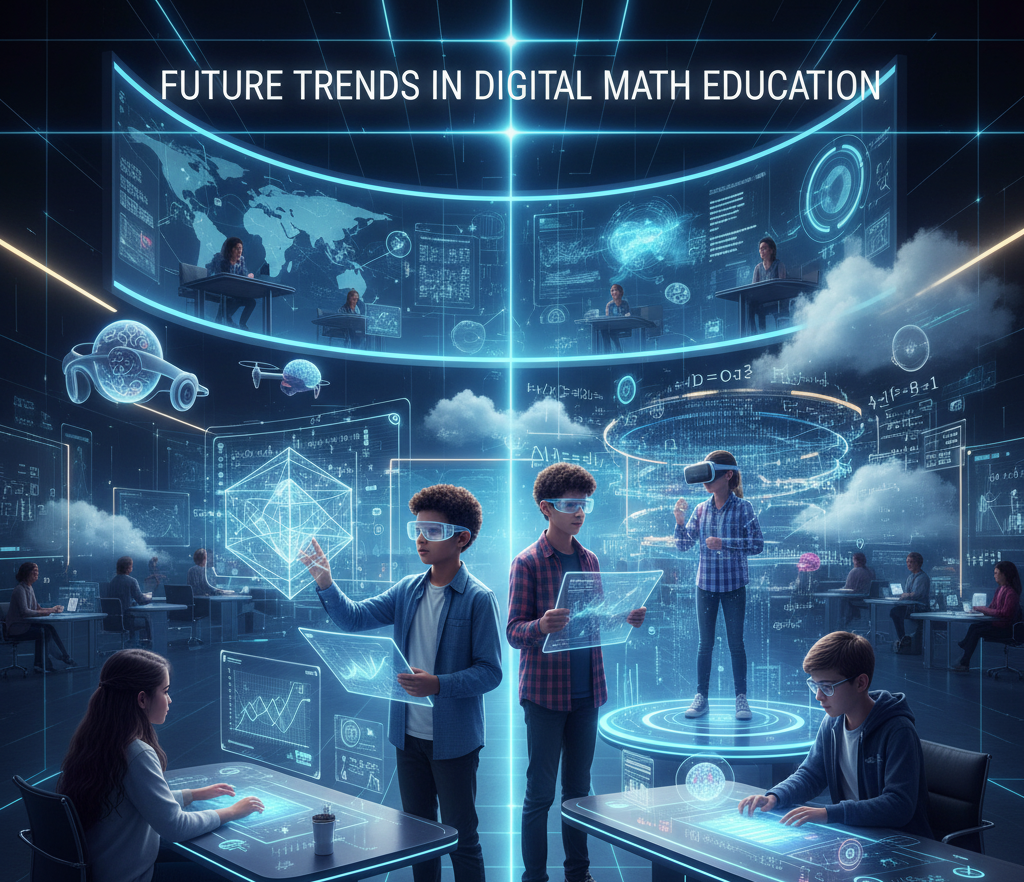
The future of mathematics education in the digital age is more exciting than ever before. Technologies that once seemed like science fiction are now becoming real tools in math classrooms around the world — and they are set to completely transform how students experience learning.
Here are the most powerful emerging technologies shaping the future of math education:
- Virtual reality math labs — students can step inside a fully immersive 3D environment where they physically interact with geometric shapes, graphs, and mathematical models in a way no textbook could ever replicate
- Augmented reality applications — by pointing a device at a real-world object, students can instantly overlay mathematical data and calculations on top of it, blending the physical and digital worlds seamlessly
- Advanced analytics systems — powerful data systems track every aspect of a student’s learning journey, giving teachers incredibly detailed insights to personalize instruction like never before
- Immersive learning experiences — combining VR, AR, and AI together creates fully engaging math environments where students learn by doing, exploring, and discovering rather than just listening
💡 The classrooms of tomorrow will not look anything like today — students will explore mathematical concepts in virtual worlds, making learning an adventure rather than a obligation.
Data-Driven Instruction
Data is becoming one of the most powerful tools available to math teachers today. Instead of guessing which students need help or which topics need more attention, educators can now make decisions based on real, accurate information collected automatically through digital platforms.
Modern digital math classrooms will increasingly rely on:
- Learning analytics — digital systems continuously collect data on how each student performs, how long they spend on each topic, and where they make the most mistakes — giving teachers a clear picture of every student’s progress
- Predictive assessment tools — advanced algorithms can identify which students are at risk of falling behind before it actually happens, allowing teachers to step in early with targeted support
- Customized content delivery — based on collected data, the system automatically delivers the right lessons, exercises, and resources to each student at exactly the right time
- Evidence-based teaching methods — instead of relying on guesswork or tradition, teachers use real classroom data to decide which teaching strategies are actually working and which need to be changed
💡 Data-driven instruction does not replace the human side of teaching — it empowers teachers to spend less time guessing and more time actually helping the students who need it most.
Best Practices for Educators
Selecting Appropriate Digital Tools
With hundreds of digital tools available today, one of the biggest challenges for educators is knowing which ones are actually worth using in their math classrooms. Choosing the wrong tool can waste valuable teaching time — so selection must be thoughtful and strategic.
When selecting technology to support mathematics education in the digital age, educators should prioritize tools that:
- Align with learning objectives — the tool must directly support what students are supposed to learn, not just entertain them with flashy features that add no real educational value
- Support diverse learning styles — a good digital math tool works for visual learners, auditory learners, and hands-on learners alike, ensuring no student is left behind
- Provide reliable performance — tools that crash, freeze, or load slowly disrupt the entire lesson, so reliability and speed are non-negotiable requirements
- Offer user-friendly interfaces — if a tool is too complicated for students or teachers to use comfortably, it will create frustration rather than improve learning
💡 The best digital tool is not always the most expensive or the most advanced — it is the one that your students can use confidently and that directly helps them understand math better.
Creating Balanced Learning Environments
Technology is a powerful tool — but too much of it can be just as harmful as too little. The most effective math classrooms are those that strike the right balance between digital innovation and traditional teaching, ensuring that technology always serves the student rather than overwhelming them.
Here is how educators can maintain this balance effectively:
- Appropriate technology integration — not every lesson needs a screen; teachers should carefully decide when digital tools genuinely add value and when a pencil and paper approach works better
- Regular evaluation and adjustment — educators should continuously review whether the digital tools they are using are actually improving student results, and be willing to make changes when something is not working
- Student feedback incorporation — students themselves are the best judges of what helps them learn; regularly asking for their input ensures that digital tools are meeting their actual needs
- Continuous improvement processes — the world of educational technology changes rapidly, so effective educators commit to staying updated and regularly refreshing their teaching strategies
💡 A balanced learning environment is not about choosing between traditional and digital — it is about knowing when to use each one to get the best possible results for every student.
Success Stories and Case Studies
Global Implementation Examples
The best proof that digital math education works is the real results being achieved by countries around the world. Several nations have already made bold moves to transform their math classrooms — and the outcomes speak for themselves.
Here are four powerful examples of countries leading the way:
- Singapore’s nationwide digital math program — Singapore consistently ranks among the top countries in global math assessments. Their success is largely built on a structured digital curriculum that combines visual learning, problem-solving apps, and data-driven teacher feedback to keep every student on track
- Finland’s phenomenon-based learning approach — Finland has moved away from traditional subject-by-subject teaching and instead uses real-world phenomena to teach math in context, supported by digital tools that make abstract concepts tangible and relevant to everyday life
- South Korea’s tech-integrated curriculum — South Korea has invested heavily in providing every student with digital devices and has built a national platform of interactive math content that teachers can access and customize for their specific classroom needs
- Canada’s innovative digital initiatives — several Canadian provinces have launched creative digital math programs that combine gamification, AI tutoring, and collaborative online projects to dramatically improve student engagement and performance
💡 These countries prove that when digital tools are implemented thoughtfully and supported by proper teacher training, the results in math education can be truly remarkable.
Conclusion: The Future of Math Learning
Mathematics education in the digital age represents a fundamental shift in how we approach teaching and learning. What once happened only inside four walls with a blackboard and textbook is now happening everywhere — on screens, through AI, inside virtual classrooms, and at each student’s own pace.
While challenges around access, equity, and teacher training still persist, the potential benefits for student engagement and understanding are truly substantial. The countries, schools, and educators who embrace this transformation thoughtfully are already seeing remarkable results.
As technology continues to evolve, digital math learning will become increasingly personalized, interactive, and effective — reaching students in ways we could not have imagined even a decade ago. The goal is simple: make quality math education available to every student, everywhere, regardless of their background or location.
If you want to explore how technology is further reshaping modern classrooms, read our detailed guide on Educational Technology and Math Learning.
💡 The future of math education is not just digital — it is smarter, fairer, and more human than ever before. The transformation has already begun — and the best is still yet to come.