Currently Empty: $0.00

 Ifat Naseem
- July 10, 2026
- Comment 0

AI vs. real math skills is the question every student using AI tools eventually has to face—are these apps teaching you, or just doing the work for you?
You’re stuck on a quadratic equation. Instead of picking up a pencil, you pick up your phone, snap a photo, and in two seconds Photomath hands you the full solution—steps and all. Or maybe you paste the question into ChatGPT and get a clean, confident explanation in return.
It feels like magic. It feels like progress. But there’s a question worth asking honestly: are these tools teaching you math or just doing it for you?
This article breaks down how AI math tools actually work, what they’re good at, where they quietly damage learning, and how to use them without losing your own mathematical thinking. If quadratic equations specifically are your weak spot, our own guide — 7 Easy Steps to Master How to Solve Quadratic Equations—is a good place to build that foundation properly.
How Photomath and ChatGPT Actually Work
It helps to understand what’s happening behind the scenes before deciding how much to trust these tools.
Photomath uses a combination of optical character recognition (to read the handwritten or printed problem) and a symbolic math engine to compute the exact solution. It then generates a step-by-step breakdown based on standard solving methods, as explained on Photomath’s official how-it-works page. Its strength is precision — for algebra, calculus, and most textbook-style problems, the math itself is almost always correct because it’s calculated, not guessed.
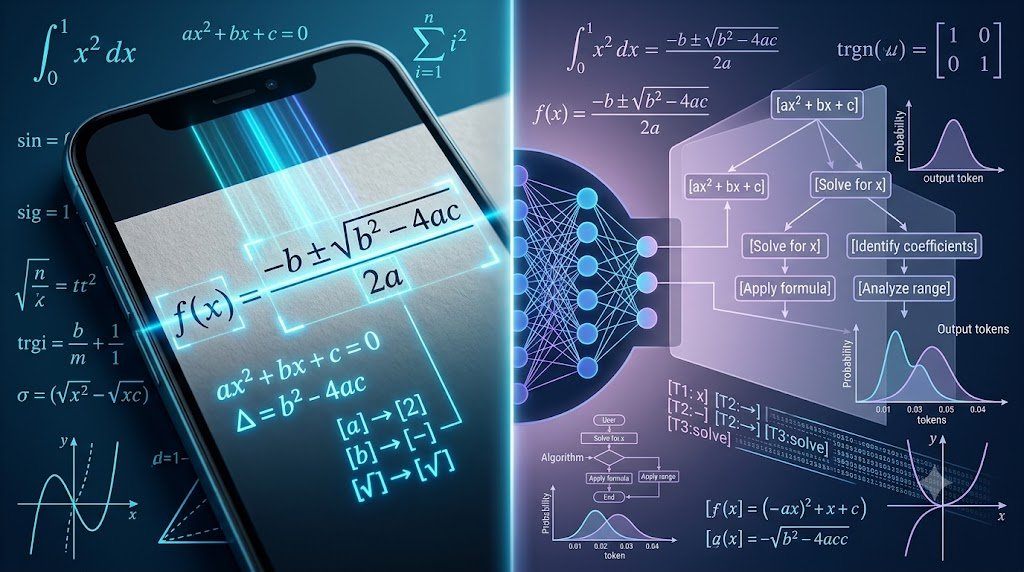
ChatGPT and similar AI chatbots, on the other hand, work differently. According to OpenAI’s own documentation, these are language models—they predict what a “correct-looking” explanation should say based on patterns learned from massive amounts of text. This means ChatGPT is often excellent at explaining concepts, walking through reasoning, and adapting language to your level. But because it isn’t running an actual calculation engine underneath, it can occasionally make computational errors, especially on multi-step or unusual problems, and state them just as confidently as correct answers.
This difference matters. Photomath is closer to a calculator with commentary. ChatGPT is closer to a tutor who’s very well-read but sometimes overconfident. Understanding this difference is the first step in the AI vs. real math skills debate—because the tool you choose changes how much you actually learn.
Where These Tools Genuinely Help
It’s not all bad news. Used correctly, AI tools can strengthen understanding rather than replace it.
- Instant feedback: You solve a problem yourself, then check your work. Catching your own mistake immediately is far more useful than waiting a day for a graded test to come back.
- Breaking down stuck points: If you understand 80% of a solution but get lost on one step, these tools can isolate exactly where the logic broke down.
- Alternate explanations: Sometimes a teacher’s explanation doesn’t click. Hearing the same concept phrased differently by an AI tool can be the thing that finally makes it make sense.
- Practice generation: ChatGPT can generate extra practice problems similar to ones you’re struggling with, which most textbooks don’t offer in unlimited supply.
Used this way, AI is a study partner, not a replacement for your brain—this is the healthy side of the AI vs. real math skills balance. If you’d rather practice with structured, verified lessons instead of relying on AI-generated ones, browse Our Courses—including Real Analysis and B.Sc Calculus with Analytic Geometry for more advanced learners.
Where They Quietly Damage Learning
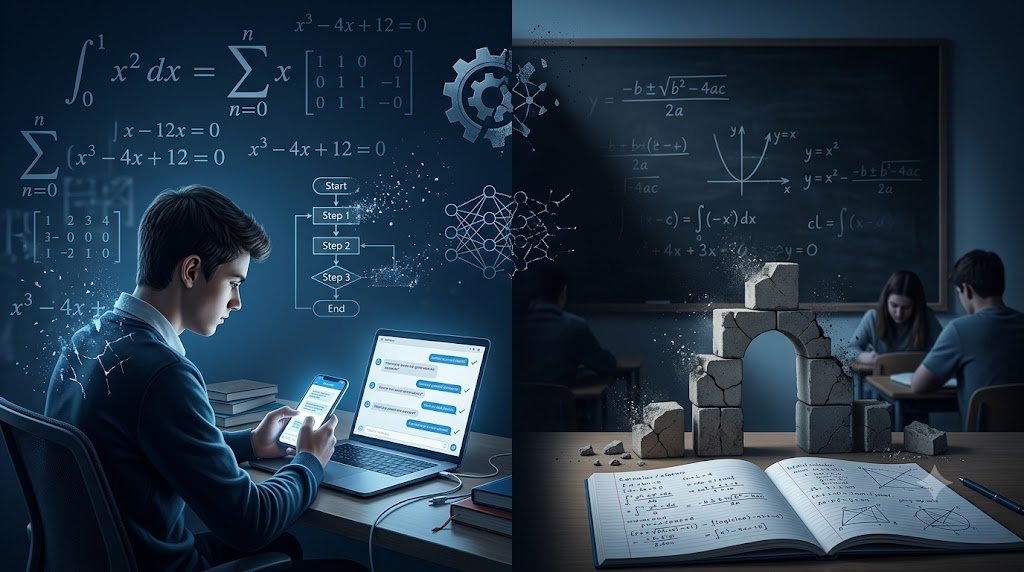
The danger isn’t in using these tools — it’s in how most students actually use them. This is where the AI vs. real math skills conflict really shows up.
1. Skipping the struggle
Mathematical understanding is built during the struggle, not during the solution. When you skip straight to the answer, you skip the exact mental process—trial, error, and adjustment—that builds real skill. Education research on “productive struggle” from ExploreLearning, along with a research brief from the Education Development Center, consistently shows that perseverance through difficulty — not passive reading of a worked solution — is what drives deeper mathematical understanding.
2. False confidence
Watching someone else solve a problem feels like understanding it. This is one of the most common traps in learning anything technical. You nod along; it makes sense in the moment, and then in the exam—with no AI to lean on—the same problem feels unfamiliar all over again. This is exactly the trap covered in our FSC Part 1 (Class 11) Mathematics Guess Paper with Solutions guide—testing yourself honestly before the real exam matters more than reviewing solved answers.
3. Losing procedural fluency
Math skills like factoring, simplifying, or manipulating equations are “use it or lose it” skills. If AI does every mechanical step for you, that fluency erodes, and slower, more basic mistakes start creeping into work you used to do automatically. Students working through 9th Class Math Solutions or 12th Class Mathematics Notes on our site should especially avoid outsourcing every step to AI—fluency at this stage is what makes advanced topics like calculus manageable later.
4. Trusting wrong answers
Because ChatGPT explains things confidently, its occasional calculation errors are easy to miss. A student who doesn’t already understand the topic has no way to catch the mistake — they simply absorb the wrong answer as fact.
AI vs Real Math Skills: What Should You Actually Choose?
If you’re still unsure where you personally stand in the AI vs. real math skills debate, ask yourself one honest question: could you solve tomorrow’s homework without opening the app? If the answer is no, the AI vs. real math skills balance has already tipped too far toward the tool and away from your own ability. The goal isn’t to pick a side in AI vs. real math skills—it’s to make sure the AI stays a support system, not your main source of thinking. Every time you lean on Photomath or ChatGPT before genuinely attempting a problem, you’re quietly voting against your own real math skills, one shortcut at a time.
AI vs Real Math Skills: Tool or Crutch?
The honest answer is that Photomath and ChatGPT are neither good nor bad on their own—it depends entirely on when in the learning process you reach for them.
| Situation | Healthy Use | Risky Use |
|---|---|---|
| Stuck after real effort | Check where you went wrong | Skip straight to the answer |
| Reviewing before an exam | Verify your own solved problems | Use AI to “solve” your revision set |
| Learning a new topic | Ask for a second explanation | Copy the AI’s homework answer directly |
| Doing homework | Attempt first, then verify | Photo the whole worksheet |
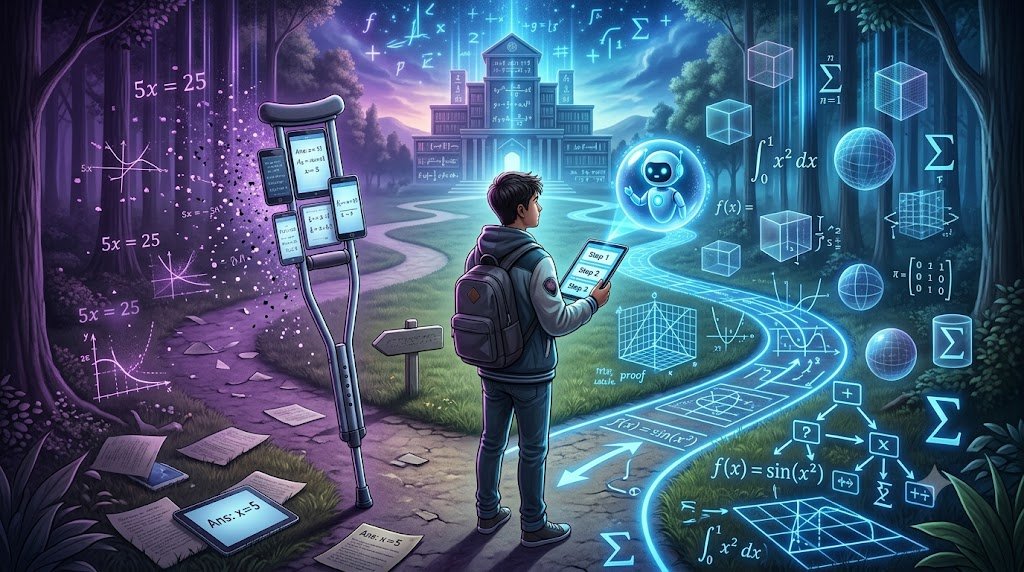
A simple rule that separates the two: if you couldn’t solve a similar problem five minutes later without the tool, you didn’t learn it—you borrowed it.
How to Use AI Math Tools Without Losing Your Skills
Balancing AI vs. real math skills doesn’t mean avoiding these tools completely—it means using them at the right moment.
- Attempt every problem yourself first, even if you get it wrong. The attempt is where the learning happens.
- Use AI to check, not to solve. Treat it like an answer key, not a starting point.
- Ask “why,” not just “what.” Instead of accepting a step, ask the tool to explain the reasoning behind it.
- Re-solve it without help a few minutes later. If you can’t, you haven’t actually learned it yet—go back and review the step you missed.
- Use it for extra practice, not primary learning. Let your teacher, textbook, or a structured course like our B.Sc Mathematical Methods by S.M. Yusuf introduce the concept; let AI reinforce it afterward.
Final Thought
AI tools like Photomath and ChatGPT aren’t killing math understanding by existing—they’re only dangerous when they replace effort instead of supporting it. Used as a mirror to check your own thinking, they can genuinely accelerate learning. Used as a shortcut to avoid thinking altogether, they quietly hollow out the exact skills math class is supposed to build.
The tools aren’t going anywhere. The real skill worth building now isn’t just math—it’s knowing when to close the app and pick up the pencil. Ready to build that foundation properly? Explore Our Courses or check out more articles on our Blog.
Frequently Asked Questions (FAQs)
1. Is using Photomath or ChatGPT for math considered cheating? It depends on how you use them. Using AI to check your own solved answers isn’t cheating — it’s smart studying. But copying answers directly onto homework or exams without attempting the problem yourself counts as cheating and prevents real learning.
2. Does using AI tools for math weaken your problem-solving skills over time? Yes, if used incorrectly. Relying on AI to solve every problem without first attempting it yourself reduces procedural fluency and weakens your ability to solve similar problems independently, especially under exam conditions.
3. Which is more accurate for math — Photomath or ChatGPT? Photomath is generally more accurate for pure calculations since it uses a symbolic math engine. ChatGPT is better at explaining concepts and reasoning but can occasionally make computational errors on complex, multi-step problems.
4. How can students use AI tools without losing real math skills? Attempt every problem yourself first, use AI only to verify your answer or clarify a specific stuck step, and try re-solving the same type of problem a few minutes later without help to confirm you actually understood it.
5. Are AI math tools good for exam preparation? They can be useful for practice and quick concept review, but they shouldn’t replace solving full past papers and guess papers under timed, no-AI conditions — that’s the only way to build genuine exam confidence.
Sources referenced:
- Photomath – Official Website
- ChatGPT – OpenAI Official Website
- The Power of Productive Struggle in Math – ExploreLearning
- Productive Struggle in Mathematics – ERIC / Education Development Center