Currently Empty: $0.00
 Ifat Naseem
- May 7, 2026
- Comment 0

What Are Crypto Price Prediction Models?
Mathematical Models for Crypto Price Prediction are powerful tools used to forecast the future prices of cryptocurrencies like Bitcoin, Ethereum, and other digital assets. These models use historical price data, statistical formulas, and machine learning algorithms to analyze market trends and identify hidden patterns.
They help traders and analysts make more informed, data-driven investment decisions by reducing emotional bias — especially important in highly volatile crypto markets.
Importance of Mathematical Models in Crypto Trading
The crypto market is extremely volatile, which makes prediction difficult without proper tools. This is where Mathematical Models for Crypto Price Prediction become important.
They help traders:
- Understand market trends
- Reduce emotional trading decisions
- Identify potential entry and exit points
- Analyze risk more effectively
By using these models, traders can improve their decision-making process significantly.
Why Mathematical Models Are Used in Crypto Trading
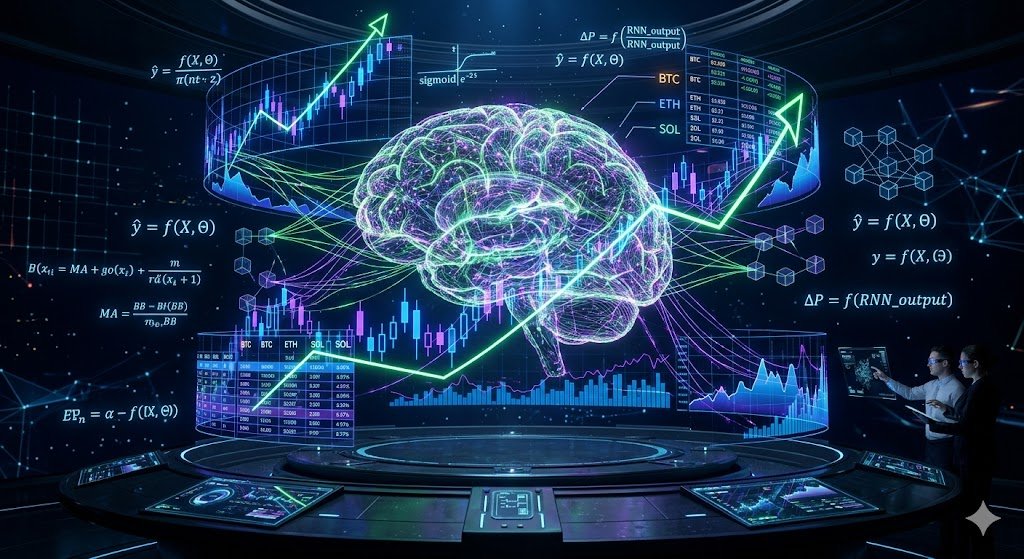
Crypto markets never sleep — they run 24 hours a day, 7 days a week, across hundreds of exchanges worldwide. Unlike stock markets, there is no central authority, no circuit breaker, and no closing bell. This makes crypto one of the most unpredictable and fast-moving markets in the world.
Human traders cannot monitor every price movement, news event, or volume spike at all times. This is exactly where mathematical models step in — they process thousands of data points every second, identify emerging patterns, and generate signals based on logic rather than fear or greed.
Another key reason is backtesting — mathematical models can be tested on years of historical data before being used in live trading. This allows traders to see how a strategy would have performed in the past, helping them refine their approach before risking real money.
Advantages of Using Mathematical Models for Crypto Price Prediction

Using Mathematical Models for Crypto Price Prediction provides several key benefits that make them essential for modern crypto traders:
- Data-driven decision making — Mathematical Models for Crypto Price Prediction rely on numbers and patterns, not emotions, removing human bias from trading decisions.
- Improved forecasting accuracy — By analyzing years of historical data, these models can identify trends that humans would easily miss.
- Better risk management — Mathematical Models for Crypto Price Prediction can calculate potential losses in advance, helping traders set stop-losses and manage their portfolio safely.
- Ability to analyze complex market behavior — Crypto markets involve hundreds of variables; these mathematical models can process all of them simultaneously.
These advantages make Mathematical Models for Crypto Price Prediction extremely popular among professional traders and hedge funds worldwide.
Popular Mathematical Models for Crypto Prediction
1. Time Series Models (ARIMA, GARCH)
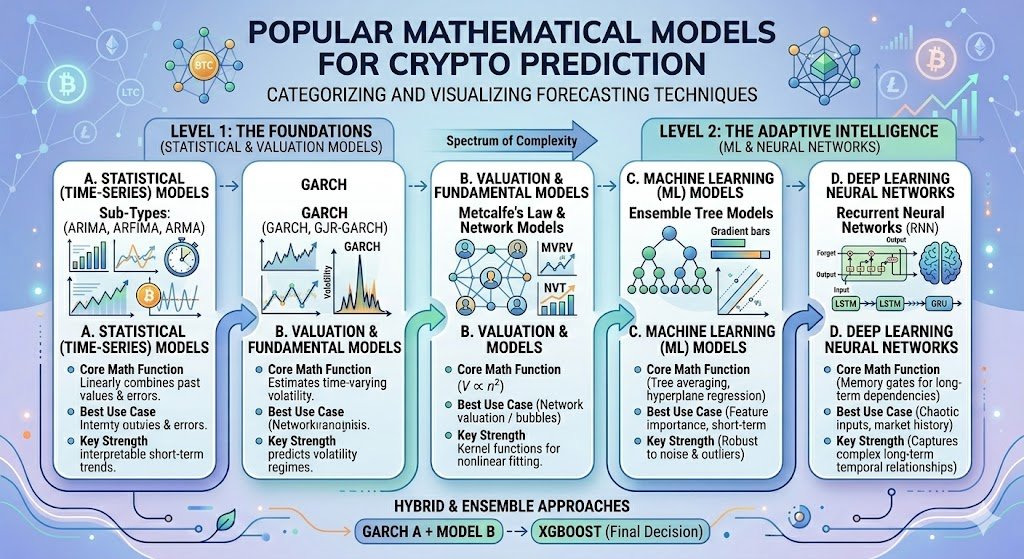
ARIMA (AutoRegressive Integrated Moving Average) is one of the most widely used models for crypto trend forecasting. It analyzes historical price data to identify patterns and predict future price movements based on past trends.
GARCH (Generalized Autoregressive Conditional Heteroskedasticity) is specifically used for volatility prediction. In crypto markets where prices swing wildly, GARCH helps traders understand how much risk they are taking at any given time.
2. Linear Regression Models
Linear Regression is the simplest mathematical model used for crypto price prediction. It draws a straight line through historical price data to estimate future prices. This model works best for short-term predictions in stable market conditions and is often used as a baseline before applying more complex models.
3. Machine Learning Models for Crypto Price Prediction
Machine Learning models are among the most powerful Mathematical Models for Crypto Price Prediction because they can learn from data automatically without being explicitly programmed.
Random Forest is an ensemble learning method that builds hundreds of decision trees simultaneously and combines their results for more accurate predictions. It is highly effective in crypto markets because it handles large datasets well and reduces the risk of overfitting.
XGBoost (Extreme Gradient Boosting) is one of the most popular machine learning algorithms used by quantitative traders. It works by building models sequentially, where each new model corrects the errors of the previous one. XGBoost is especially powerful for short-term crypto price prediction because of its speed and high accuracy.
Neural Networks are inspired by the human brain and consist of multiple layers of interconnected nodes. They are capable of recognizing extremely complex and non-linear patterns in crypto price data that traditional statistical models completely miss. Neural networks form the foundation of modern AI-based trading systems.
4.Deep Learning Models (LSTM, RNN) for Crypto Price Prediction
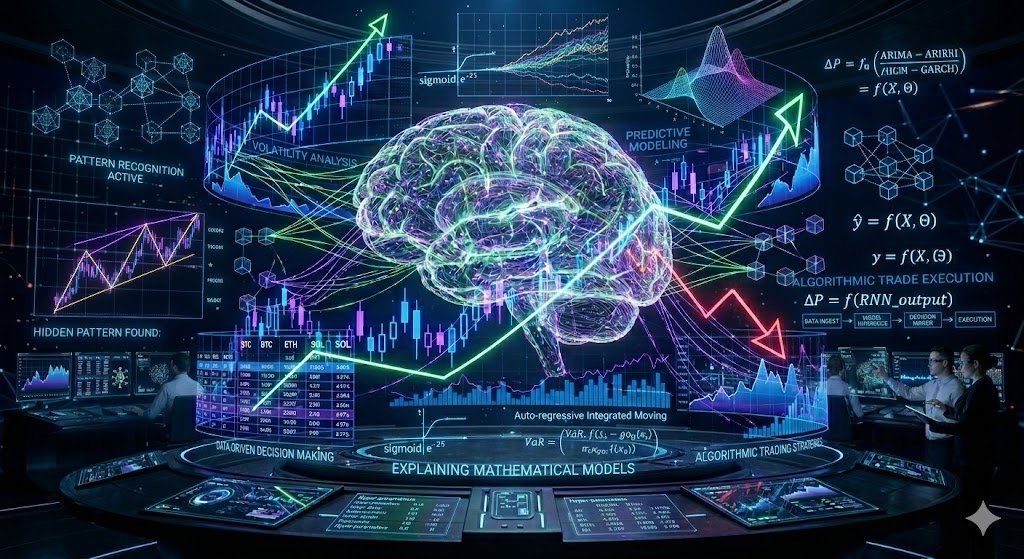
Deep Learning models are the most advanced Mathematical Models for Crypto Price Prediction available today. Unlike traditional models, they can process large sequences of historical data and learn complex time-based patterns automatically.
LSTM (Long Short-Term Memory) is currently the most popular deep learning model used in Bitcoin and crypto price forecasting. What makes LSTM special is its ability to remember long-term patterns while also reacting to short-term price changes. For example, LSTM can remember that every time Bitcoin dropped 20% in a week, it recovered within 30 days — and use that pattern to predict future behavior.
RNN (Recurrent Neural Network) is the foundation on which LSTM is built. It processes data sequentially — meaning it looks at prices one by one in order, just like reading a sentence word by word. However, basic RNNs struggle with very long sequences, which is why LSTM was developed as an improved version specifically designed to handle long-term crypto price data more effectively.
Together, LSTM and RNN are widely used by AI-powered trading platforms and hedge funds for real-time Bitcoin forecasting and automated trading strategies.
AI + Mathematical Hybrid Models for Crypto Price Prediction
Traditional statistical models like ARIMA and GARCH are good at capturing trends and volatility, but they struggle with complex, non-linear patterns in crypto markets. On the other hand, Machine Learning models like LSTM and Random Forest are powerful at recognizing hidden patterns but lack the mathematical structure of classical models. Hybrid models combine both to get the best of both worlds.
For example, a hybrid model might use ARIMA to capture the linear trend in Bitcoin prices, and then pass the residuals (errors) to an LSTM neural network to learn the non-linear patterns that ARIMA missed. The final prediction combines both outputs, giving significantly better accuracy than either model alone.
These hybrid approaches are widely used in hedge funds and quantitative trading firms because they reduce prediction error and handle market volatility more effectively. Companies like Two Sigma and Renaissance Technologies use similar hybrid Mathematical Models for Crypto Price Prediction strategies to make data-driven trading decisions worth billions of dollars.
Limitations of Mathematical Models for Crypto Price Prediction
While Mathematical Models for Crypto Price Prediction are powerful tools, they are not perfect. Every trader must understand their limitations before relying on them completely.
Market Manipulation is one of the biggest challenges these models face. Crypto markets are largely unregulated, which means large investors known as “whales” can artificially pump or dump prices within minutes. No mathematical model can predict such deliberate manipulation because it does not follow any natural pattern or historical trend.
Sudden News Impact is another major limitation. A single tweet from Elon Musk, a government ban announcement, or an exchange hack can instantly crash or skyrocket crypto prices. These models are built on historical data and simply cannot account for unexpected real-world events that have never happened before.
Black Swan Events are rare but extremely powerful events that completely break all mathematical predictions. The 2020 COVID crash, the FTX collapse in 2022, and the Terra Luna crash are perfect examples. These events were so unusual and extreme that even the most advanced Mathematical Models for Crypto Price Prediction failed to predict them.
This is why experienced traders always combine mathematical models with their own judgment and never rely on any single model completely.
Real-World Use Cases of Mathematical Models for Crypto Price Prediction
Mathematical Models for Crypto Price Prediction are not just theoretical concepts — they are actively being used in the real world by some of the biggest names in crypto and finance.
Binance Trading Bots are one of the most common real-world applications. Binance, the world’s largest crypto exchange, allows traders to deploy automated bots that use mathematical models to buy and sell cryptocurrencies 24/7 without human intervention. These bots use LSTM, ARIMA, and machine learning algorithms to analyze price movements in real-time and execute trades within milliseconds.
Quantitative Trading Firms like Two Sigma, Jump Trading, and Cumberland DRW use advanced hybrid mathematical models to trade Bitcoin and other cryptocurrencies at massive scale. These firms employ teams of mathematicians and data scientists who build and refine prediction models that process millions of data points every second to find profitable trading opportunities.
AI Crypto Apps like Pionex, 3Commas, and Cryptohopper have made Mathematical Models for Crypto Price Prediction accessible to everyday traders. These apps use machine learning and deep learning models behind the scenes, allowing even beginners to benefit from AI-powered predictions without needing any mathematical knowledge themselves.
Future of Crypto Price Prediction Using Mathematical Models
The future of Mathematical Models for Crypto Price Prediction is incredibly exciting. As technology continues to evolve rapidly, these models are becoming faster, smarter, and more accurate than ever before.
Quantum Computing is expected to completely revolutionize crypto price prediction in the coming years. Traditional computers process data one step at a time, but quantum computers can process millions of calculations simultaneously. This means quantum-powered Mathematical Models for Crypto Price Prediction will be able to analyze entire market histories in seconds, identifying patterns that current models simply cannot detect. Companies like IBM and Google are already working on quantum computing solutions that could transform financial markets forever.
AI-Driven Trading Systems are the next big evolution in crypto trading. Instead of traders manually selecting and running models, fully autonomous AI systems will continuously learn from live market data, automatically switch between different mathematical models depending on market conditions, and execute trades without any human involvement. These systems will combine LSTM, Bayesian models, and hybrid approaches all in one intelligent platform.
Real-Time Prediction Engines are already being developed by top crypto firms. These engines process live price data, social media sentiment, news headlines, and on-chain blockchain data simultaneously to generate Mathematical Models for Crypto Price Prediction signals within milliseconds. In the future, these engines will become so advanced that they will predict market movements before they even happen.
Internal Linking
How to Calculate Crypto Profit: 5 Formulas Every Beginner Must Know
Mathematical Models for Crypto Price Prediction Using AI and Statistics
🌍 External Authority Links
Link to:
Binance Academy
Investopedia crypto forecasting
How Mathematical Models for Crypto Price Prediction Work
Mathematical Models for Crypto Price Prediction work by collecting and analyzing three main types of data — historical price data, trading volume, and market indicators like RSI, MACD, and Bollinger Bands. This raw data is then cleaned and organized before being fed into mathematical formulas or machine learning algorithms.
The process works in four simple steps:
- Data Collection — Historical prices, volume, and market indicators are gathered from exchanges like Binance and Coinbase.
- Pattern Detection — Mathematical formulas and algorithms scan this data to identify repeating trends, cycles, and anomalies.
- Model Training — The model is trained on years of historical data so it learns how the market behaved in different conditions.
- Price Forecasting — Finally, the trained model generates a prediction about future price movements based on current market data.
It is important to understand that Mathematical Models for Crypto Price Prediction do not guarantee accuracy. Crypto markets are influenced by human emotions, news events, and unpredictable factors that no model can fully capture. However, these models significantly reduce uncertainty by replacing emotional guesswork with structured, data-driven analysis — giving traders a much stronger foundation for their decisions.
Conclusion
In conclusion, Mathematical Models for Crypto Price Prediction play a vital role in understanding and analyzing crypto markets. While they are not perfect and cannot fully eliminate uncertainty, they provide valuable insights that help traders make smarter, data-driven decisions.
These models are becoming increasingly important as more investors enter the crypto market. They combine historical data analysis, probability theory, and machine learning techniques to identify hidden price patterns that are not visible to the human eye. By using these structured mathematical approaches, traders can better understand market volatility and improve their chances of making informed and strategic investment decisions.
As technology continues to evolve, especially with the integration of AI, deep learning, and quantum computing, Mathematical Models for Crypto Price Prediction are expected to become even more accurate and widely used in real-world trading strategies — making them an essential part of modern crypto analysis.