Currently Empty: $0.00
 Ifat Naseem
- January 28, 2026
- Comment 13

Why Math Matters More Than Market Predictions
Every financial market produces two types of traders: those who survive and grow, and those who slowly drain their accounts. What separates them is rarely talent or luck. The real separator is how well they understand numbers.
Many beginners approach trading as a guessing game, trying to forecast where price will move next. Professionals don’t trade this way. They focus on controlling losses, measuring probabilities, and applying repeatable calculations. This structured approach is what stock market math represents.
Markets will always move unpredictably. Your edge comes from how you respond to that uncertainty using logic instead of emotion.One of the main reasons traders fail is ignoring the principles of stock market math. By relying on intuition rather than calculations, they expose themselves to unnecessary risk and emotional decisions. Understanding and applying stock market math ensures that every trade is measured, consistent, and aligned with long-term goals.
Measuring Risk and Reward Before You Trade
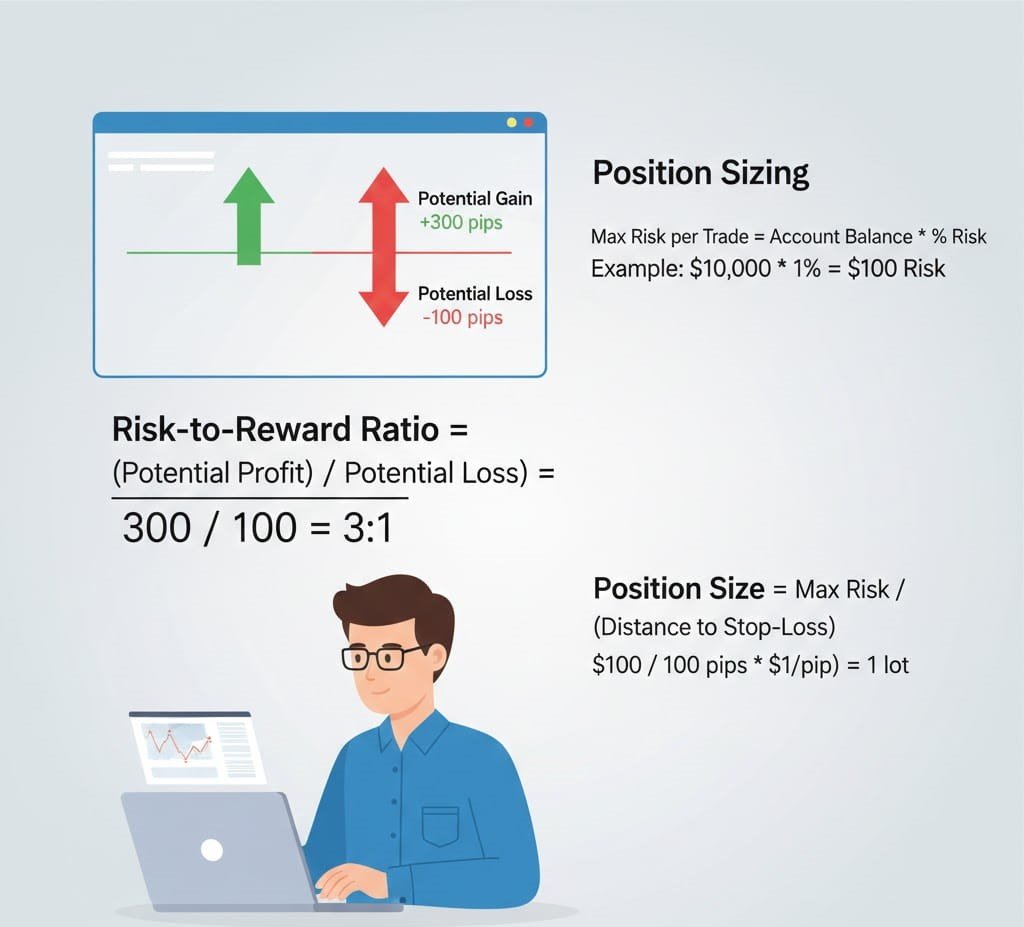
A trade should never be entered without knowing two things: how much you can lose and how much you can gain.
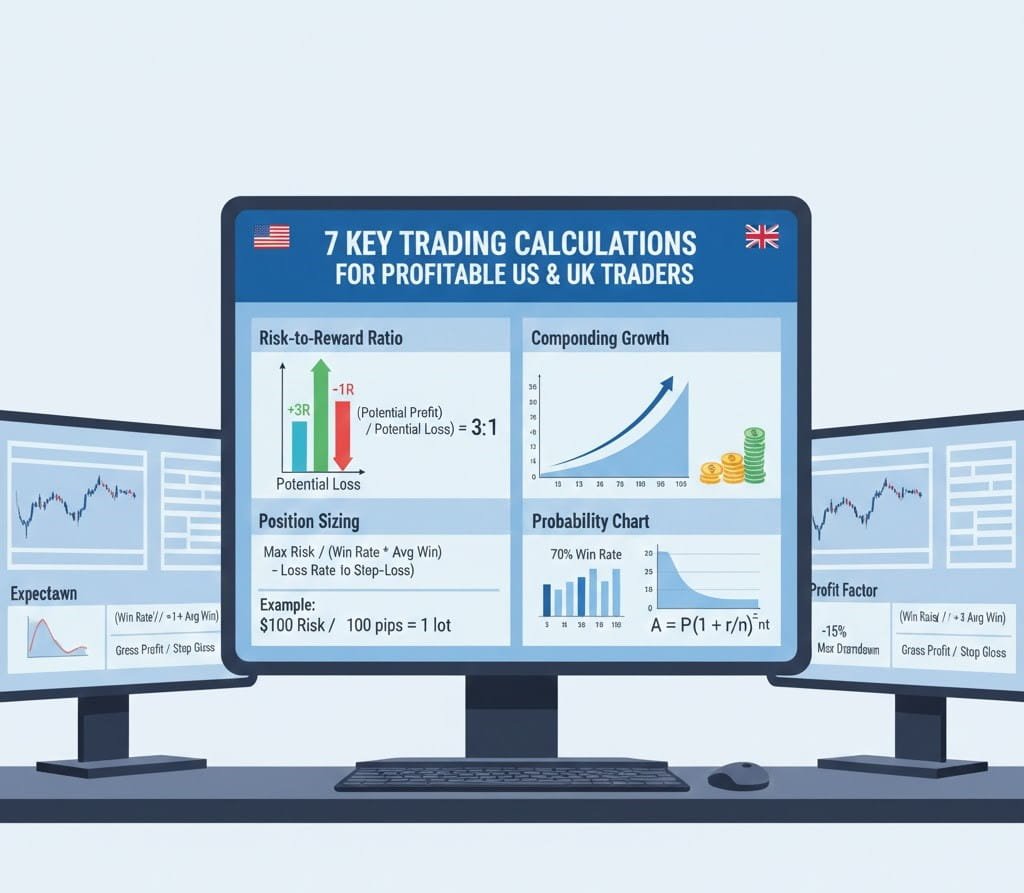
This relationship is expressed through the risk-to-reward ratio. This is where stock market math becomes practical rather than theoretical. By quantifying potential losses and expected gains before entering a position, traders remove guesswork and ensure every decision aligns with predefined risk limits.
Risk-to-Reward Calculation
Risk-to-Reward = Expected Gain ÷ Possible Loss
For instance, risking $100 to make $300 gives a 1:3 ratio.
This matters because profitability does not depend on winning often. With favorable ratios, a trader can lose more trades than they win and still grow their account. That’s why experienced traders reject setups where losses outweigh potential gains.
Position Sizing: Limiting Damage from Bad Trades
Position sizing answers a critical question: how much should I trade?
Rather than guessing, professionals use a formula that links account size, acceptable risk, and stop-loss distance.
Position Size Formula
Position Size = (Account Balance × Risk %) ÷ Stop-Loss Value
Example:
Account balance: $50,000
Risk per trade: 1% ($500)
Stop-loss distance: $10
Position size = 500 ÷ 10 = 50 shares
This calculation prevents any single trade from causing serious harm and allows traders to remain consistent over hundreds of trades.
Trading as a Probability Exercise
Markets do not reward perfection. They reward consistency.
Instead of asking, “Will this trade win?” professionals ask, “Is this strategy profitable over many trades?”
That’s where expectancy comes in.
Expectancy Formula
Expectancy = (Probability of Win × Average Gain) − (Probability of Loss × Average Loss)
A positive expectancy means the strategy makes money over time, even if losses occur frequently. This mindset removes emotional attachment to individual trades.
Compounding: The Silent Growth Engine
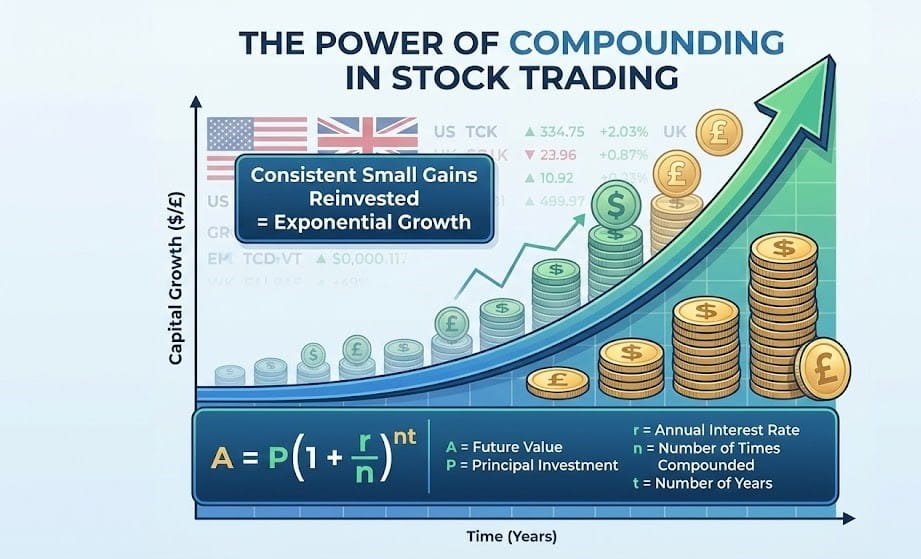
Compounding is what allows small, steady gains to turn into meaningful capital growth.
Compounding Equation
Future Value = Starting Capital × (1 + Rate of Return)ⁿ
Traders who prioritize steady performance benefit far more from compounding than those who chase large, unstable profits. Time and consistency do most of the heavy lifting.
Understanding Your Break-Even Point
Losses are unavoidable in trading. What matters is knowing how many losses your strategy can tolerate.
Break-Even Win Rate Formula
Break-Even Rate = Risk ÷ (Risk + Reward)
With a 1:3 setup, the break-even rate is:
1 ÷ (1 + 3) = 25%
This means winning just one out of four trades prevents losses overall. Knowing this helps traders stay calm during drawdowns.
Volatility: Adjusting Risk to Market Conditions
Volatility describes how aggressively prices move. Higher volatility increases both opportunity and danger.
Professional traders respond by:
Widening or tightening stop-losses
Reducing position sizes
Trading less frequently
Statistical tools like standard deviation help quantify volatility so decisions remain objective rather than emotional.
Moving Averages: Simplifying Market Direction
Moving averages reduce noise and highlight trends.
Simple Moving Average (SMA)
SMA = Sum of Prices ÷ Number of Periods
They help traders:
Stay aligned with momentum
Avoid trading against dominant price movement
Because of their simplicity, moving averages remain widely used across all markets.
Risk Control: The Foundation of Long-Term Survival
No strategy survives without risk control.
Most professional traders limit risk to 1–2% per trade. This ensures they can withstand losing streaks without blowing up their account.
Without proper risk limits, even a strong strategy can fail due to poor execution.
Why Traders Lose When They Ignore the Math
Most trading failures come from avoidable errors:
❌ Oversizing trades
❌ Ignoring calculated risk levels
❌ Emotional decision-making
❌ No statistical evaluation
❌ Trying to recover losses quickly
These problems are mathematical, not market-related.
Why These Principles Apply to Every Market
Whether you trade US stocks, UK equities, commodities, or digital assets, the math remains unchanged. Instruments differ, but risk, probability, and compounding are universal.
That’s why experienced traders trust numbers more than opinions or news headlines.
Trading Success Is Built on Structure, Not Speculation
Financial markets reward discipline far more than bold predictions. Every day, traders in the US and UK place thousands of trades, yet only a small percentage achieve consistent profitability. The difference is not access to secret indicators or insider information. It’s the presence of structure in decision-making.
Successful trading operates within clear rules. These rules define how much to risk, when to exit, and how to stay objective during uncertainty. Without this structure, emotions dominate decisions, often leading to unnecessary losses and inconsistency.
In professional trading environments, decisions are driven by calculations rather than opinions. Numbers provide clarity where emotions create confusion. This numerical foundation is what separates calculated operators from impulsive gamblers in modern financial markets.
Final Thoughts: Trade Like an Operator, Not a Gambler
Trading is not about predicting the future. It’s about managing uncertainty.
When you rely on stock market math, you replace guesswork with structure. Over time, this approach creates consistency, confidence, and control the traits that define professional traders.
If your goal is long-term success in US or UK markets, let calculations guide every decision.
FAQs
- Is advanced mathematics required for trading?
No. Basic arithmetic, probability, and discipline are enough. - What calculations do professionals rely on most?
Risk-to-reward, position sizing, expectancy, and volatility measurement. - Is trading more calculation-driven than investing?
Yes. Trading demands frequent risk and probability assessment, while investing focuses on long-term fundamentals.
Trading & Investing Math for Beginners: Simple Numbers That Help You Grow Money Safely - mathmystry.com
[…] Trading & Investing Math for Beginners also offers a structured approach to analyzing opportunities, managing capital, and making logical financial decisions. When applied correctly, trading and investing math for beginners helps traders reduce losses, increase potential gains, and maintain discipline in fluctuating market conditions.For a deeper dive into essential formulas used by top traders, check out our guide on Stock Market Math: 7 Key Calculations Used by Profitable US & UK Traders. […]
Ifat Naseem
“Thanks for sharing! 😊 Trading and investing math is such an important tool for beginners. Using structured approaches and key formulas can really help reduce losses, increase gains, and make smarter financial decisions.”
Top 5 Mathematical Strategies to Maximize Your Crypto Profits in 2026 - mathmystry.com
[…] succeed in volatile markets, it’s essential to understand how mathematical strategies to maximize your crypto profits can guide your decisions. Traders who incorporate math into their trading plan are able to minimize losses and systematically […]
Ifat Naseem
Absolutely! Incorporating mathematical strategies in crypto trading is a smart way to minimize risks and maximize profits. Thanks for highlighting this important point!
Ifat Naseem
“Absolutely! 📈 Incorporating mathematical strategies into crypto trading can make a huge difference. Understanding the numbers helps traders minimize losses and make smarter, more systematic decisions.”
How to Calculate Crypto Profit | Easy Formula for Beginners - mathmystry.com
[…] Most beginners make a big mistake—they ignore extra costs. Let’s fix that. […]
Ifat Naseem
Absolutely! Accounting for extra costs is crucial, especially for beginners. Thanks for highlighting this important point!
Ifat Naseem
“Absolutely! ✅ Ignoring extra costs is a common mistake for beginners. Keeping track of all fees and expenses is essential to truly understand your profits and make smarter investment decisions.”
Bitcoin Investment Case Study: How Early Investors Made Millions - mathmystry.com
[…] Stock Market Math US/UK – Learn essential math skills for trading in global markets (Read more). […]
Ifat Naseem
Absolutely! Understanding essential math skills is key for trading success in global markets. Thanks for sharing your insight!
Ifat Naseem
“Thanks for sharing! 📈 Learning essential stock market math skills is crucial for trading successfully in both US and UK markets. Great resource for anyone looking to improve their trading knowledge!”
5 Steps to Apply the Money Formula Most People Ignore - mathmystry.com
[…] guides. Learn how to enhance your crypto earnings in Risk to Reward Ratio in Bitcoin Trading, or master key calculations with Stock Market Math: 7 Essential Formulas. Beginners can also benefit from our Trading & Investing Math for […]
Ifat Naseem
“Thank you for your insights! We appreciate your tips on crypto trading and stock market math. We encourage our readers to explore verified resources and continue learning smart investing strategies.”